We've mapped 'Natural Park Areas (boundary),' 'Special Zones,' and 'Special Protection Zones' under Japan's Natural Parks Act — plus MAPRISE's own reference layer for 'Ordinary Zones' — starting with the Kyushu 7 prefectures. Here's the legal background, how it ties to real-estate disclosure, and what real-estate, development, finance, professional, and government users should each watch for.
Hello from the MAPRISE team. This time we're introducing a layer for zones under Japan's Natural Parks Act — the areas within national and quasi-national parks where restrictions on land use are strictest. We're starting with the Kyushu 7 prefectures.
What the Natural Parks Act is
Enacted in 1957, this law protects Japan's outstanding natural scenic areas while promoting their use, so that they contribute to public health, recreation, and education. There are three types of designated natural parks.
- National Park: Japan's most outstanding natural scenic areas, designated by the Minister of the Environment.
- Quasi-National Park: scenic areas ranking just below national parks, designated by the Minister of the Environment and managed by the prefecture.
- Prefectural Natural Park: scenic areas within a prefecture, designated and managed by the prefecture under its own ordinance (Article 73, Paragraph 1 of the Act).
Four layers: boundary, Special Zone, Special Protection Zone, and Ordinary Zone
A natural park's designated area isn't a single uniform zone — it's internally divided. Here are the four layers we've implemented.
Natural Park Area (boundary)
The outer boundary of the entire area designated as a national park, quasi-national park, or prefectural natural park. Everything inside this boundary falls into one of three zones — Special Zone, Special Protection Zone, or Ordinary Zone — introduced below. This layer itself doesn't show which zone applies; it's simply the park's outer frame.
Special Zone (Article 20, Paragraph 3)
A zone where permission is required to carry out acts defined by law — constructing, rebuilding, or extending structures, felling trees and bamboo, extracting minerals, reclaiming water surfaces, and so on. The permitting authority is the Minister of the Environment for national parks and the prefectural governor for quasi-national parks.
Special Protection Zone (Article 21, Paragraph 3)
Designated within Special Zones where nature conservation needs are especially high. An even broader range of acts requires permission here than in an ordinary Special Zone — including collecting or damaging plants and animals, and setting fires — making this the most tightly regulated zone within a park. The same permitting authority applies as for Special Zones.
Ordinary Zone (reference / derived layer) — a MAPRISE-specific reference category
Under the law, an Ordinary Zone is defined as "an area not included in a Special Zone or a Marine Park Zone" (Article 33, Paragraph 1). Building a structure above a certain size requires advance notification — 30 days before starting work — but unlike Special Zones and Special Protection Zones, this is not a permission requirement.
There's an important accuracy caveat for this layer. The source data (Japan's National Land Numerical Information) doesn't include a polygon for the Ordinary Zone itself. So MAPRISE derives it by taking the "Natural Park Area (boundary)" layer, subtracting the Special Zone, and clipping the remainder to land-based administrative boundaries — this is reference information, not a polygon from the original source. Marine Park Zones (Article 22, Paragraph 3) are also excluded from Ordinary Zones under the law, but since we don't have Marine Park Zone data, we can't account for them — meaning that in parks that include marine areas, this layer may display a larger Ordinary Zone than actually exists. For the precise boundaries, please check with the prefecture or the Ministry of the Environment's regional office in charge of nature conservation.
How this relates to real-estate disclosure
Area designations under the Natural Parks Act are one of the legal restrictions that must be explained as part of the disclosure statement, under Article 3, Paragraph 1, Item 31 of the enforcement order of Japan's Building Lots and Buildings Transaction Business Act. Specifically, this covers Article 20, Paragraph 3 (Special Zone), Article 21, Paragraph 3 (Special Protection Zone), Article 22, Paragraph 3 (Marine Park Zone), Article 33, Paragraph 1 (Ordinary Zone), Article 48, and Article 73, Paragraph 1 (prefectural natural parks, excluding provisions related to use-coordination districts).
For MAPRISE users: what matters depending on your role
The Natural Parks Act is one of those laws that rarely comes up in the normal course of business. But once you're running a business professionally — earning compensation for it — "I didn't know" isn't really an option. We place this layer in MAPRISE's "Legal Restrictions & Zones" group, since it can be relevant to disclosure-statement work, and we see it being useful in different ways depending on your role.
- Real estate brokers: check whether a property you're brokering falls within a natural park zone, as part of preparing the disclosure statement.
- Developers / funds: whether a Special Zone or Special Protection Zone requires permission, or an Ordinary Zone requires notification, directly affects your development schedule.
- Banks (lending): if the collateral property falls within a regulated zone, that can constrain future land use or disposal options — a relevant factor in credit review.
- Legal & appraisal professionals: efficiently grasp which restrictions apply to a given zone when preparing an appraisal report or researching legal restrictions in advance.
- Local government: use this to cross-check against other administrative plans, such as urban planning or landscape planning, and to get a fuller picture of an area's natural resources.
Try it: across Kyushu
Here's what it looks like when you display Kyushu in MAPRISE.
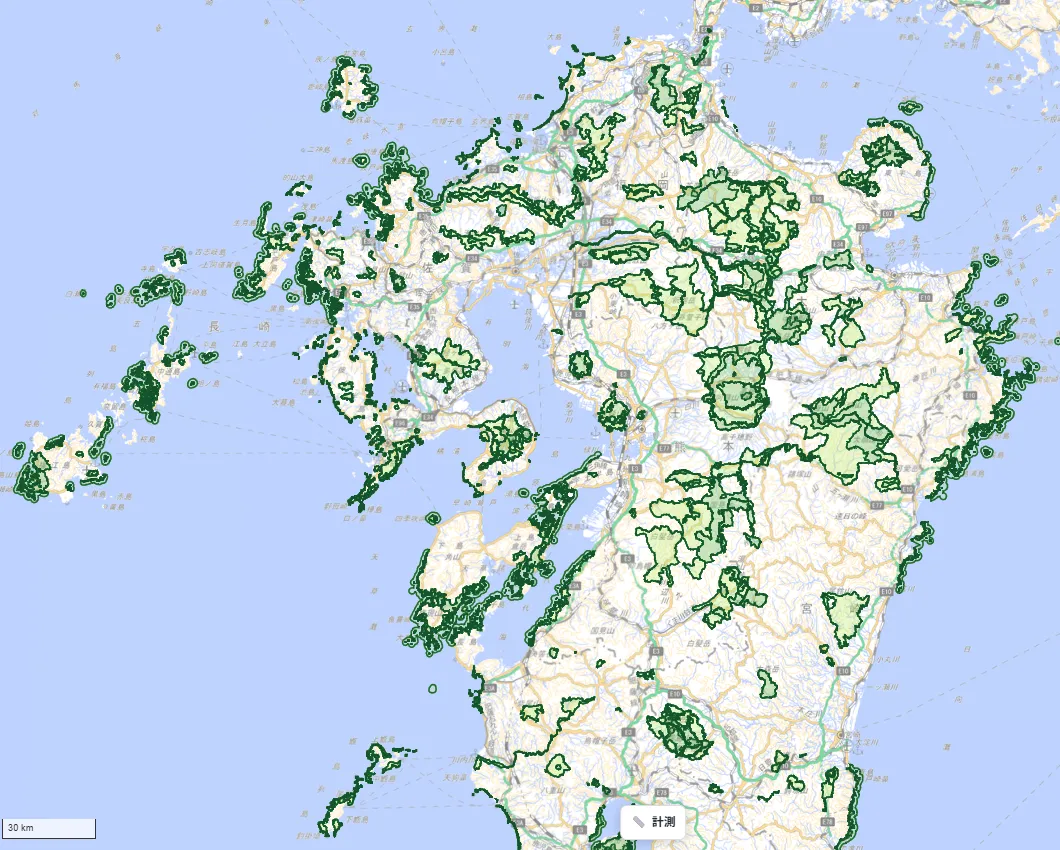
Numerous natural park zones are distributed across the Kyushu 7 prefectures, concentrated mainly along the coastline and in mountainous areas.
Try it: around Karatsu City and Genkai Town (Genkai Quasi-National Park)
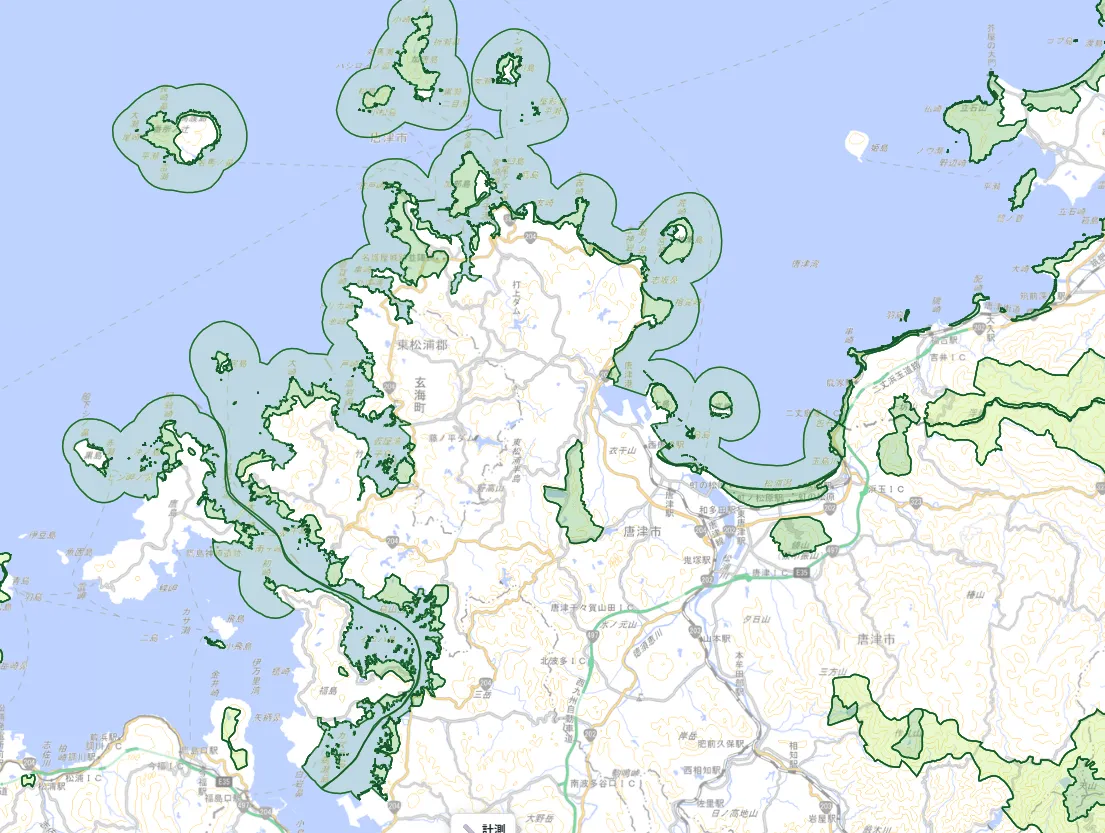
This area, spanning Karatsu City and Genkai Town, is part of the Genkai Quasi-National Park, which covers the scenic Genkai Sea coastline. The intricate rias coast and its many islands are finely subdivided into Special Zones. The light-blue band spreading along the coast is also a visible example of the Ordinary Zone layer's caveat — that it can display a larger area than reality because Marine Park Zone data isn't accounted for.
Try it: Kumamoto (Aso-Kuju National Park and Unzen-Amakusa National Park)
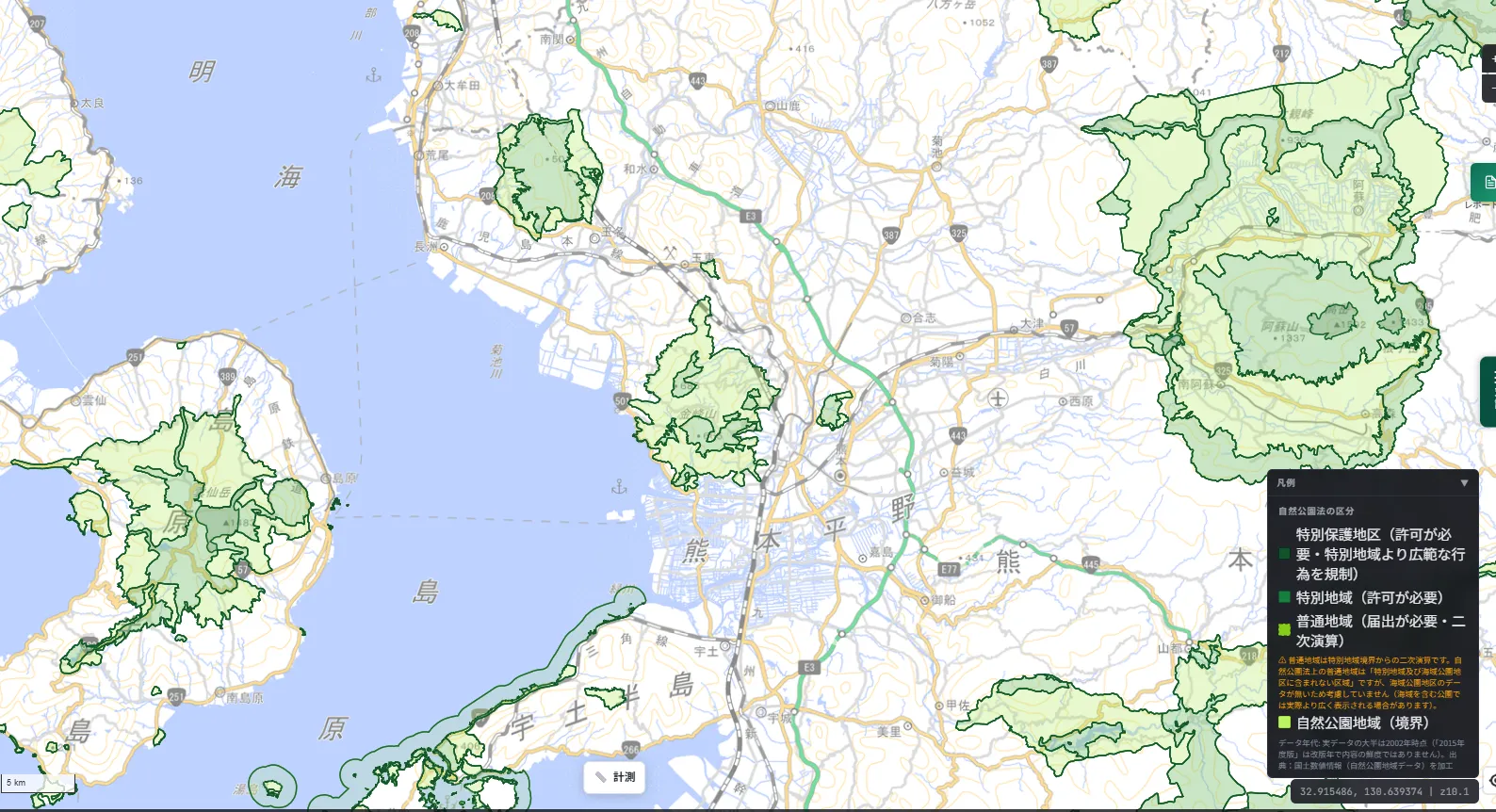
The dark green area visible around the crater of Mount Aso, on the right side of the screen, is a Special Protection Zone. The Shimabara Peninsula in the lower left is part of Unzen-Amakusa National Park, designated around Mount Unzen-Fugen. In a single screen, you can see the full range of zone types — from the most tightly regulated Special Protection Zone to the comparatively relaxed Ordinary Zone.
Try it: Kagoshima (Sakurajima, Kirishima-Kinkowan National Park)
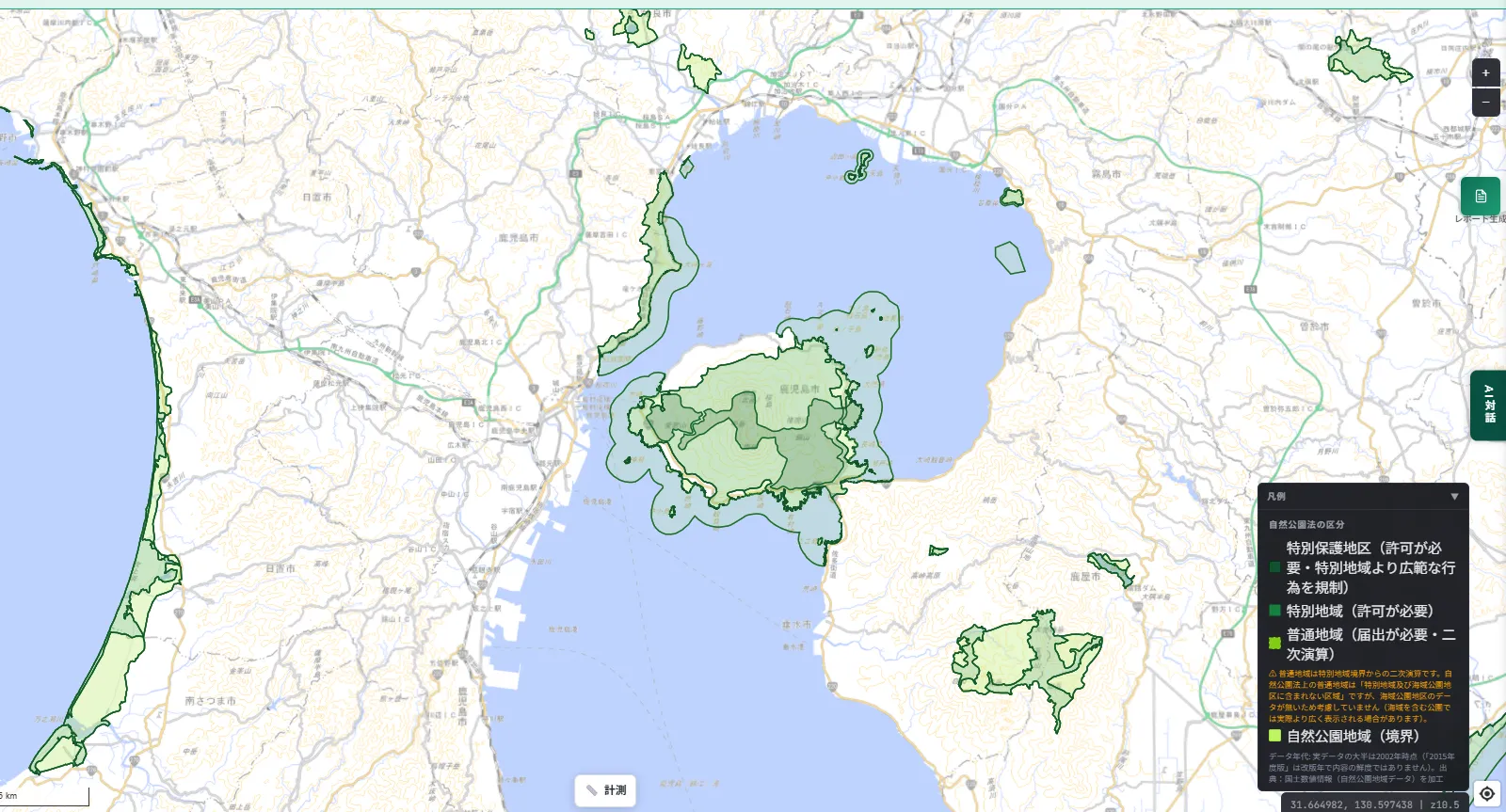
The active volcano Sakurajima is designated as part of Kirishima-Kinkowan National Park. You can clearly see on the map how the zoning gets stricter in concentric rings the closer you get to the crater. The light-blue area spreading across the water is, again, a spot where the Ordinary Zone layer's reference-data nature shows through.
What clicking tells you
Clicking a zone on the map shows an explanation and source in a popup.
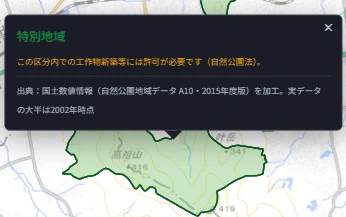
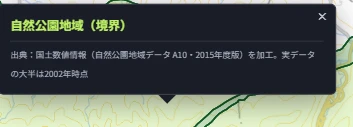
Both popups explicitly state the caveat about data recency.
How to read the legend
The legend has four categories: Special Protection Zone, Special Zone, Ordinary Zone (derived layer), and Natural Park Area (boundary).
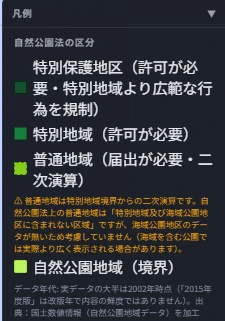
Being upfront about data accuracy and recency
This layer is built by processing the "Natural Park Area" data from Japan's National Land Numerical Information (Ministry of Land, Infrastructure, Transport and Tourism, CC BY 4.0). The data is published as the "FY2015 edition," but that refers to the revision year, not how current the content is — most (89%) of the actual data for the Kyushu 7 prefectures dates from 2002. Because designations can change, please check with the prefecture or the Ministry of the Environment's regional office for the latest status.
The Ordinary Zone layer is also reference information MAPRISE derived through a secondary calculation, with no polygon directly corresponding to it in the source data. Because Marine Park Zone data doesn't exist, parks that include marine areas may show a larger Ordinary Zone than actually exists.
About coverage
This layer currently covers the Kyushu 7 prefectures only. Nationwide expansion is something we're treating as a future development task.
Closing
Laws like this one rarely surface in the normal course of business — but once you're running a business professionally, for compensation, "I didn't know" doesn't really hold up. Being able to efficiently understand and track this kind of information matters whether you're in real estate, finance, a licensed profession, or government. We provide this layer as part of MAPRISE's "Legal Restrictions & Zones" group, and hope it proves useful in disclosure-statement work.
Questions or feedback are always welcome at info@maprise.jp.
The Natural Parks Act zone data (Natural Park Area boundary, Special Zone, Special Protection Zone) introduced in this post is reference information created by processing the "Natural Park Area" data from Japan's National Land Numerical Information (Ministry of Land, Infrastructure, Transport and Tourism, CC BY 4.0). It currently covers the Kyushu 7 prefectures only, and most (89%) of the underlying data dates from 2002. The Ordinary Zone layer is reference information MAPRISE derived through a secondary calculation; it does not account for Marine Park Zone data and may display a larger area than actually exists. Please check with the prefecture or the Ministry of the Environment's regional office for details and the latest designation status. For how this relates to disclosure obligations under the Building Lots and Buildings Transaction Business Act in a specific transaction, please consult a licensed real-estate transaction specialist or other qualified professional.
Tags: #Natural Parks Act #Environmental regulation #Real estate disclosure #Kyushu #Land acquisition
Other-language share text (exception cases)
Quick share above follows our platform-locked language policy (X-family in Japanese, LinkedIn in English). The four panes below let you grab the opposite-language body when needed — e.g. introducing an English post to a Japanese audience on X, or posting a Japanese article to LinkedIn in Japanese. Each pane offers both a copy button and a direct intent link.
📝 自然公園法の特別地域・特別保護地区を地図にしました(九州先行公開)
自然公園法に基づく「自然公園地域(境界)」「特別地域」「特別保護地区」、そしてMAPRISE独自の参考区分「普通地域(二次演算)」を、九州7県先行で地図レイヤーとして実装しました。法律の背景、重要事項説明との関係、不動産・ディベロッパー・金融・士業・自治体それぞれが気にすべき点を紹介します。
https://maprise.jp/ja/blog/natural-park-special-areas/ #自然公園法 #環境規制
🆕 新しいブログ記事を公開しました。

《自然公園法の特別地域・特別保護地区を地図にしました(九州先行公開)》

自然公園法に基づく「自然公園地域(境界)」「特別地域」「特別保護地区」、そしてMAPRISE独自の参考区分「普通地域(二次演算)」を、九州7県先行で地図レイヤーとして実装しました。法律の背景、重要事項説明との関係、不動産・ディベロッパー・金融・士業・自治体それぞれが気にすべき点を紹介します。

👉 詳しくはこちら: https://maprise.jp/ja/blog/natural-park-special-areas/
📝 Special Zones and Protection Zones Under the Natural Parks Act, Mapped (Kyushu First)
We've mapped 'Natural Park Areas (boundary),' 'Special Zones,' and 'Special Protection Zones' under Japan's Natural Parks…
https://maprise.jp/en/blog/natural-park-special-areas/ #NaturalParksAct #Environmentalregulation
🆕 New on the MAPRISE blog.

《Special Zones and Protection Zones Under the Natural Parks Act, Mapped (Kyushu First)》

We've mapped 'Natural Park Areas (boundary),' 'Special Zones,' and 'Special Protection Zones' under Japan's Natural Parks Act — plus MAPRISE's own reference layer for 'Ordinary Zones' — starting with the Kyushu 7 prefectures. Here's the legal background, how it ties to real-estate disclosure, and what real-estate, development, finance, professional, and government users should each watch for.

👉 Read the full post: https://maprise.jp/en/blog/natural-park-special-areas/

#NaturalParksAct #Environmentalregulation #Realestatedisclosure #Kyushu #Landacquisition