We've mapped designated areas under Japan's Soil Contamination Countermeasures Act — both 'action-required areas' and 'notification areas' — nationwide. What people using well water or home vegetable gardens should know, how this relates to real-estate disclosure, and what corporations and individuals should each watch for.
Hello from the MAPRISE team. This time, we're introducing a layer related to something that matters wherever you're standing: soil contamination. We've mapped the designated areas under Japan's Soil Contamination Countermeasures Act.
What the Soil Contamination Countermeasures Act is
This law came into effect in February 2003 to determine the state of soil contamination and prevent the health damage it can cause. When a facility that used hazardous substances (such as on a former factory site) is decommissioned, or when land above a certain size undergoes alteration, that triggers a survey. Prefectures and designated cities investigate the state of soil contamination, and where it exceeds the standard, the land is designated as a specific type of area.
There are 26 "specified hazardous substances" covered by the law, falling broadly into three categories: volatile organic compounds such as trichloroethylene and benzene (Category 1), heavy metals such as lead, arsenic, mercury, and hexavalent chromium (Category 2), and pesticides and PCBs (Category 3).
Two exposure pathways, two types of area
The key thing about this law is that it doesn't just look at contamination itself — it also considers how that contamination could actually reach a person, and designates areas accordingly.
- Exposure via groundwater, etc.: hazardous substances in the soil dissolve into rainwater and mix into groundwater, which then enters the body. All 26 substances have a "soil leaching standard" set with this pathway in mind.
- Direct ingestion: the soil itself ends up in someone's mouth. Of the 26 substances, 9 have a "soil content standard" set with this pathway in mind.
Whether either of these exposure pathways exists determines which of two area types applies.
- Action-required area (shown in red on the map): contamination exists, and an exposure pathway exists too (there's a risk of health damage). Under Article 9, altering the land's form is prohibited in principle, and measures to remove the contamination, as directed by the prefectural governor, are required.
- Notification area (shown in green on the map): contamination exists, but no exposure pathway is present, so there's no immediate risk of health damage. Even so, under Article 12, Paragraph 1, notification is required at least 14 days before altering the land's form.
What matters if you use well water or have a home vegetable garden
The "exposure pathway" concept above becomes a lot more concrete once you connect it to daily life.
If you live somewhere that uses (or might start using) well water for daily life or drinking, the "soil leaching standard" — the groundwater exposure pathway — is directly relevant. It's worth checking whether a designated area exists nearby beforehand.
For anyone who spends a lot of time with their hands in the soil in a home vegetable garden, the "soil content standard" — the direct-ingestion pathway — isn't irrelevant either. To be clear, being inside a designated area doesn't automatically mean anything is wrong with what you're growing there. But we think there's real value in simply knowing how many designated areas exist within the area where you actually live.
How this relates to real-estate disclosure
Area designations under the Soil Contamination Countermeasures Act are one of the legal restrictions that must be explained as part of the disclosure statement, under Article 3, Paragraph 1, Item 32 of the enforcement order of Japan's Building Lots and Buildings Transaction Business Act. Specifically, this covers matters relating to Article 9 (the prohibition on altering land within an action-required area) and Article 12, Paragraph 1 (the notification requirement for altering land within a notification area).
What companies (real-estate businesses, developers) should watch for
If you're handling land that may have hosted a facility using hazardous substances in the past — a former factory site or dry-cleaning shop, for example — we'd recommend checking early on whether it falls into a designated area. If it's an action-required area, altering the land's form (grading, excavation, and so on) is prohibited in principle, which directly affects your development plan. Even for a notification area, the pre-construction notification procedure adds a step you'll want to build into your schedule.
What individuals should watch for
When considering buying a home or acquiring land, it's reassuring to check whether the target site or the surrounding area falls into a designated area. Being in a designated area doesn't by itself mean living there is a problem — but if you have concrete plans like using well water or starting a vegetable garden, this is information worth knowing ahead of time.
Try it: nationwide overview
Here's what it looks like when you display all of Japan in MAPRISE.
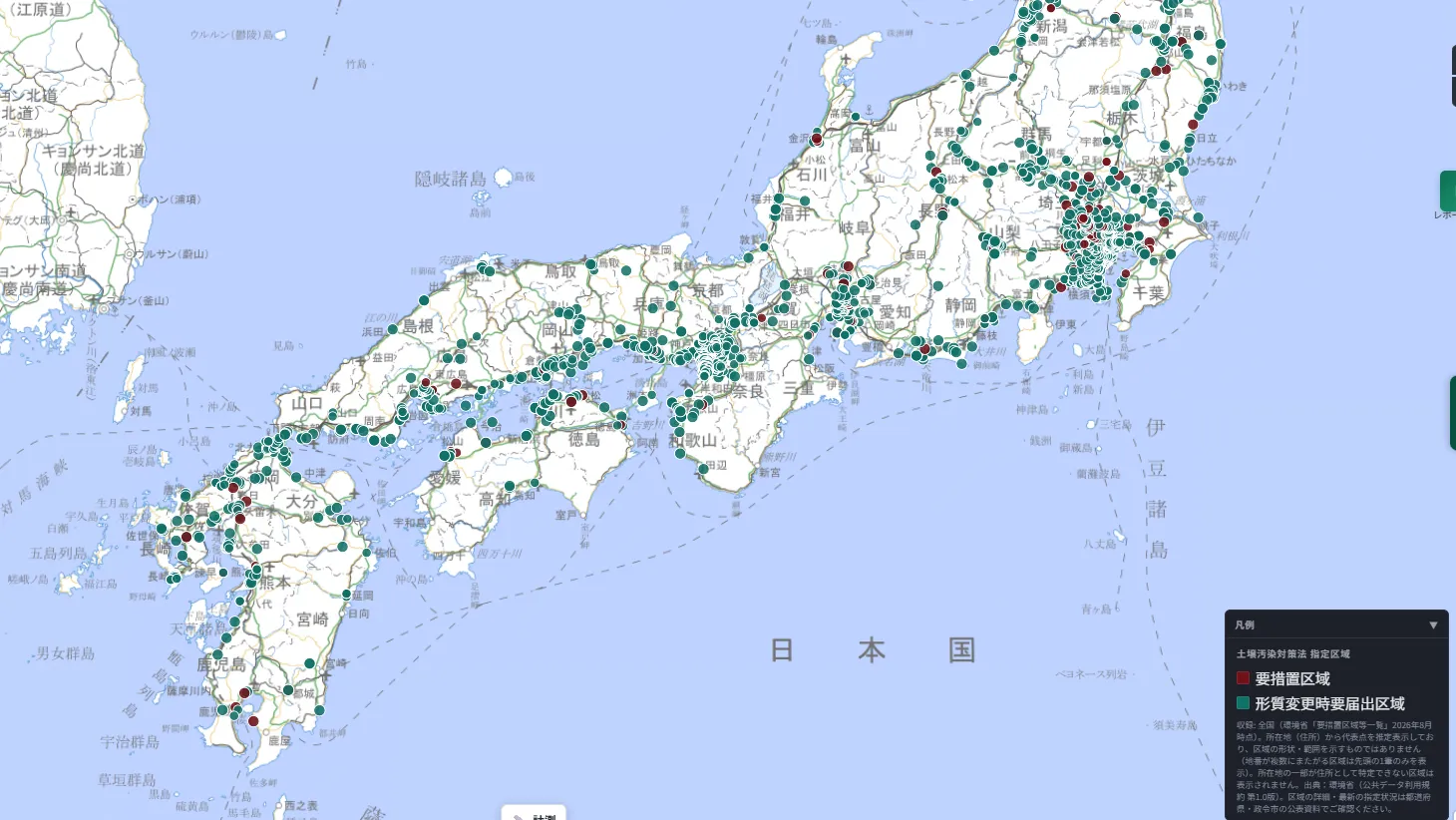
Designated areas are distributed nationwide, concentrated mainly in the urban centers of Kanto, Kinki, and Chubu.
Try it: Tokyo
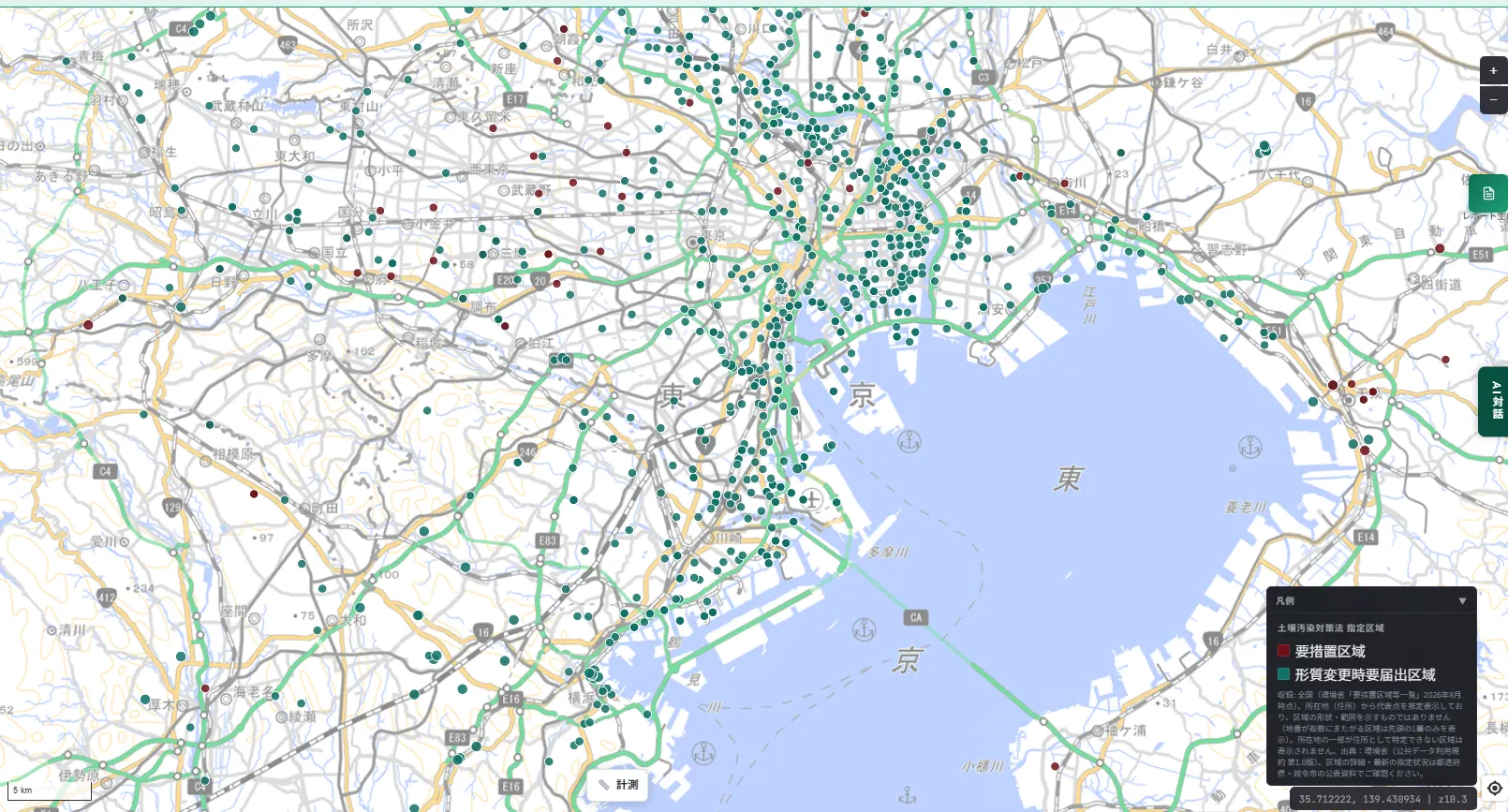
Designated areas are densely concentrated around the city center — a distribution that seems to reflect the long industrial history of a major metropolis.
Try it: Osaka
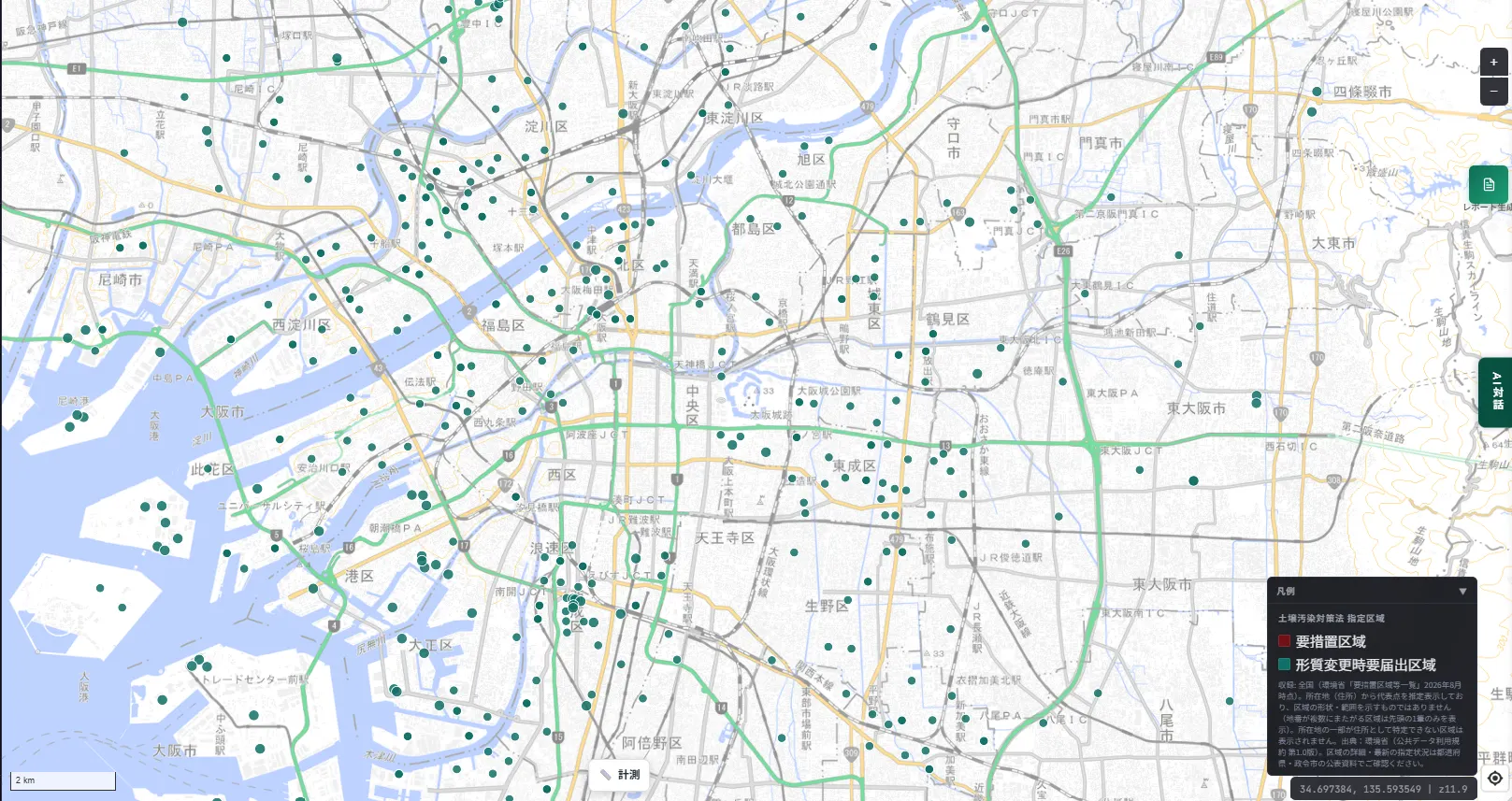
A similarly dense distribution appears around Osaka's waterfront area.
Try it: Nagoya
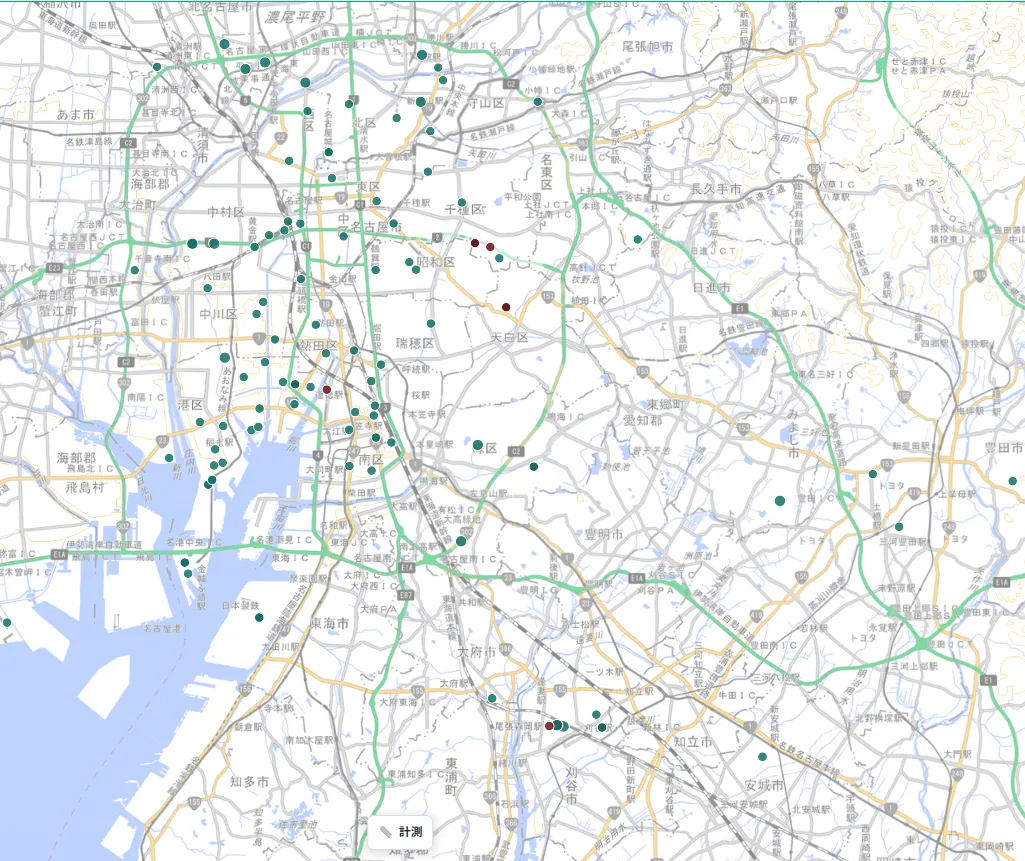
In Nagoya, you can spot several action-required areas (red) in addition to notification areas (green).
What clicking tells you
Clicking a marker on the map shows the details of that designated area.
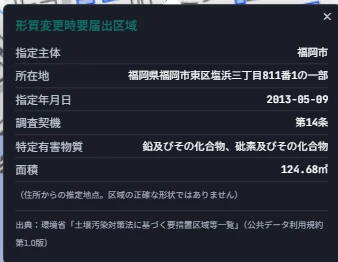
You can see the designating authority, location, designation date, survey trigger, specified hazardous substances, and area, all in one place. In this example, you can also tell that the survey trigger was Article 14 — an application for area designation based on a voluntary survey conducted by the landowner.
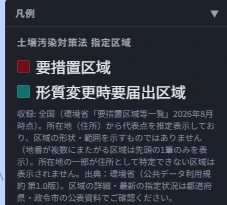
How to read the legend
The legend has two categories: action-required area (red) and notification area (green).
About coverage
This layer covers all of Japan (Ministry of the Environment's "List of Action-Required Areas, etc." as of August 2026). That said, the displayed position is an estimated representative point based on the location (address) — it does not indicate the exact shape or extent of the area. Where an area spans multiple parcels, only the first parcel is shown, and areas whose location can't be identified from the address are not shown at all. For details and the latest designation status, please check the materials published by the relevant prefecture or designated city.
Closing
Land that was once a factory or a shop being reborn as a residential or commercial area is a familiar sight all across Japan. There's no easy way to know everything about how a piece of land was used in the past, but at least for legally designated areas, this layer now makes that easy to check. We hope it's useful for land-acquisition and real-estate work, and also as a way to learn a bit more about the history of the town you live in.
Questions or feedback are always welcome at info@maprise.jp.
The Soil Contamination Countermeasures Act designated area data introduced in this post is reference information created from the Ministry of the Environment's "List of Action-Required Areas, etc. under the Soil Contamination Countermeasures Act" (as of August 2026, Public Data Usage Agreement Version 1.0). The displayed position is an estimated representative point based on the location (address); it does not indicate the exact shape or extent of the area. Please check the materials published by the relevant prefecture or designated city for details and the latest designation status. For how this relates to disclosure obligations under the Building Lots and Buildings Transaction Business Act in a specific transaction, please consult a licensed real-estate transaction specialist or other qualified professional.
Tags: #Soil contamination act #Environmental risk #Real estate disclosure #Nationwide #Land acquisition
Other-language share text (exception cases)
Quick share above follows our platform-locked language policy (X-family in Japanese, LinkedIn in English). The four panes below let you grab the opposite-language body when needed — e.g. introducing an English post to a Japanese audience on X, or posting a Japanese article to LinkedIn in Japanese. Each pane offers both a copy button and a direct intent link.
📝 その土地、汚れていませんか? ― 土壌汚染対策法の指定区域を地図にしました
土壌汚染対策法に基づく『要措置区域』『形質変更時要届出区域』を、全国分まとめて地図レイヤーとして実装しました。地下水・井戸水を使う地域や家庭菜園をされている方が知っておきたい観点、重要事項説明との関係、法人・個人それぞれが注意すべき点を紹介します。
https://maprise.jp/ja/blog/soil-contamination-designated-areas/ #土壌汚染対策法 #環境リスク
🆕 新しいブログ記事を公開しました。

《その土地、汚れていませんか? ― 土壌汚染対策法の指定区域を地図にしました》

土壌汚染対策法に基づく『要措置区域』『形質変更時要届出区域』を、全国分まとめて地図レイヤーとして実装しました。地下水・井戸水を使う地域や家庭菜園をされている方が知っておきたい観点、重要事項説明との関係、法人・個人それぞれが注意すべき点を紹介します。

👉 詳しくはこちら: https://maprise.jp/ja/blog/soil-contamination-designated-areas/
📝 Is That Land Contaminated? — We Mapped Soil Contamination Designated Areas
We've mapped designated areas under Japan's Soil Contamination Countermeasures Act — both 'action-required areas' and 'notification a…
https://maprise.jp/en/blog/soil-contamination-designated-areas/ #Soilcontaminationact #Environmentalrisk
🆕 New on the MAPRISE blog.

《Is That Land Contaminated? — We Mapped Soil Contamination Designated Areas》

We've mapped designated areas under Japan's Soil Contamination Countermeasures Act — both 'action-required areas' and 'notification areas' — nationwide. What people using well water or home vegetable gardens should know, how this relates to real-estate disclosure, and what corporations and individuals should each watch for.

👉 Read the full post: https://maprise.jp/en/blog/soil-contamination-designated-areas/

#Soilcontaminationact #Environmentalrisk #Realestatedisclosure #Nationwide #Landacquisition