We've mapped cemetery locations nationwide. Here's the data overview, why cemetery proximity matters as a (non-mandatory) factor in real-estate site selection, and a look at how burial practices in Japan have changed over time — including a small number of dedicated cemeteries that accommodate Muslim burial.
Hello from the MAPRISE team. Many people probably remember, as a child, finding it a little unnerving to walk past a cemetery — the kind of place ghost stories are set in, or where a game of dare might take you. As adults, though, most of us come to see a cemetery very differently: a place where people rest peacefully, nothing unsettling about it at all.
At the same time, when it comes to selecting a piece of real estate, whether there's a cemetery nearby can be one factor people weigh. So this time, we're introducing a "cemeteries" layer showing cemetery locations nationwide.
Being upfront about the data
Here's exactly what this layer contains.
- Coverage: 34,971 cemeteries nationwide, based on OpenStreetMap (as of September 2026)
- Display format: shown as location markers. Names exist for only some points — roughly 14% coverage.
- Operator type: this data doesn't currently distinguish between municipal, private, and temple-run cemeteries.
- Muslim burial-accommodating cemeteries: of these, 11 have been individually identified as burial-accommodating, based on Wikipedia's "List of Islamic Cemeteries in Japan" and related research. These are shown with a distinct gold-rimmed marker.
- Layer ID:
cemeteries - Data source: OpenStreetMap (ODbL 1.0) / burial-accommodating cemeteries via Wikipedia + individual research
- Reflected in MAPRISE as of: September 23, 2026 (updated on an irregular schedule)
Cemetery proximity as a factor in real-estate site selection
Cemetery proximity is not one of the items legally required to be explained in a disclosure statement under Article 3, Paragraph 1 of the enforcement order of Japan's Building Lots and Buildings Transaction Business Act. Nor does it fall under the Ministry of Land, Infrastructure, Transport and Tourism's 2021 "Guidelines on the Disclosure of a Death on the Property" — those guidelines cover deaths that occurred on the property itself (suicide, homicide, solitary death, etc.), not the existence of a nearby cemetery.
In practice, though, a property adjacent to a cemetery is often treated in the real-estate industry as one of the "undesirable neighboring facilities," sometimes disclosed voluntarily or factored into a property's marketability and value. Precisely because it isn't a legal requirement, how much attention to pay to it is a judgment call that varies by who's asking. We hope this layer serves as one input into site selection and asset valuation.
What clicking tells you
Clicking a point on the map shows the facility name, type, and source in a popup.
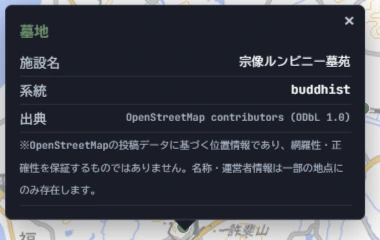
A burial-accommodating cemetery's popup shows more detailed information.
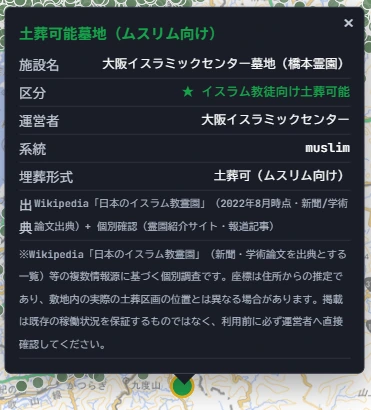
This cemetery in Hashimoto City, Wakayama Prefecture, operated by the Osaka Islamic Center, is one of the few burial-accommodating cemeteries in the Kansai region.
Try it: Kinki and Chubu
Here's what it looks like when you display the Kinki and Chubu regions in MAPRISE.
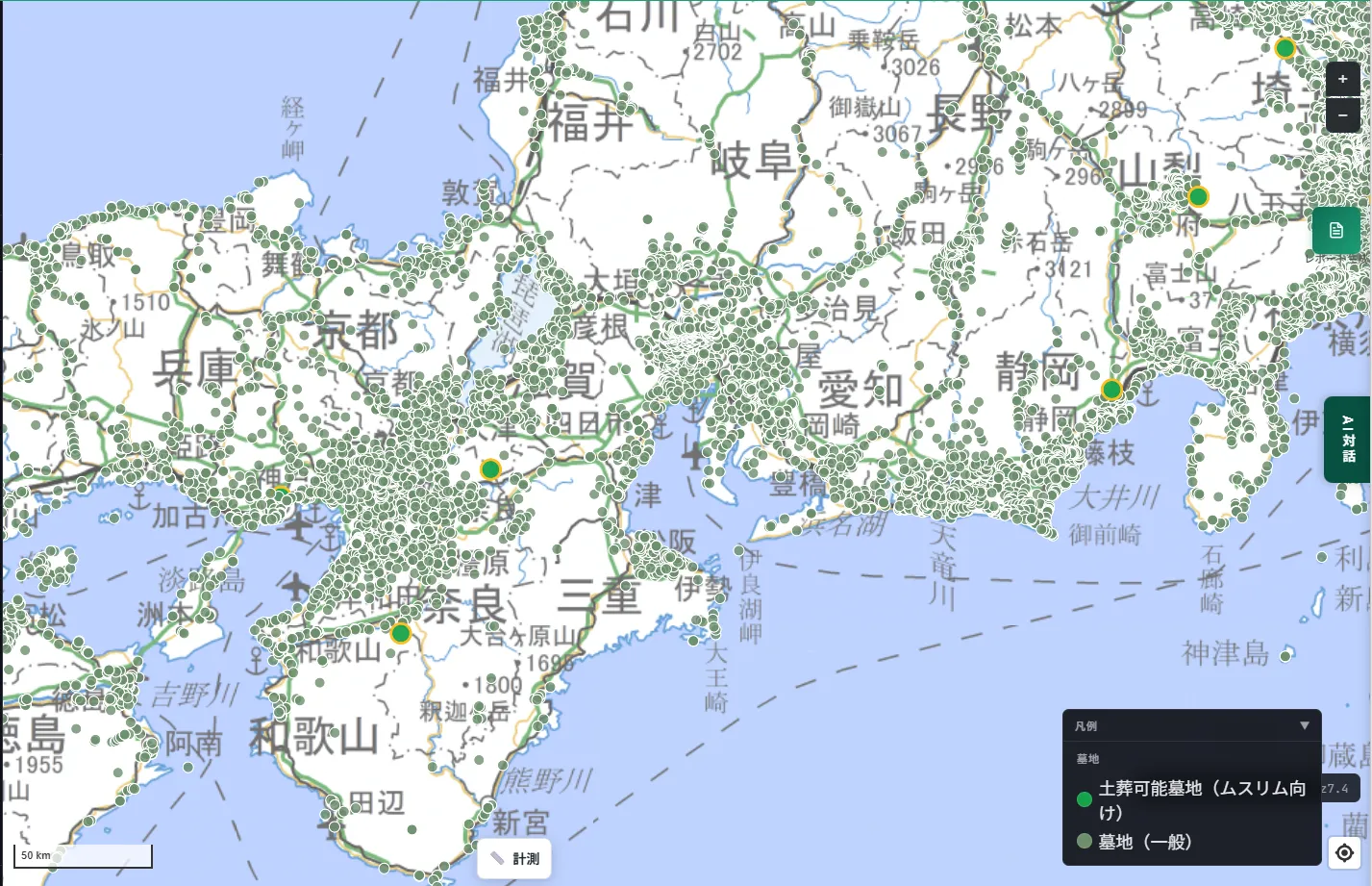
Cemeteries appear at very high density around Kyoto, Osaka, and Nara. A few gold-rimmed markers for burial-accommodating cemeteries are visible within that density.
Try it: Kanto and Koshinetsu
Here's what it looks like across the Kanto and Koshinetsu regions.
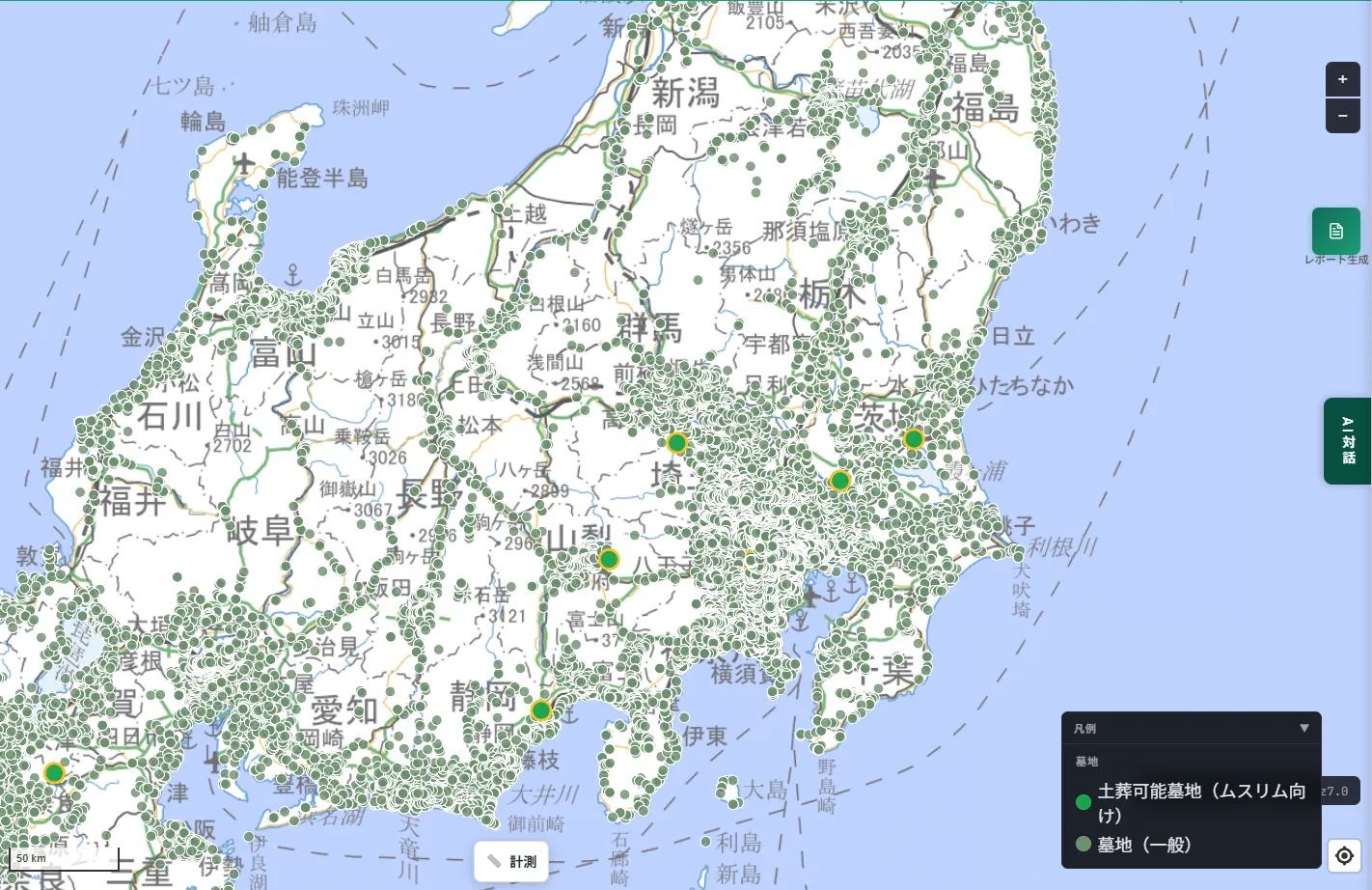
Numerous cemeteries are distributed across the greater Tokyo area and into Koshinetsu. These include long-established burial-accommodating cemeteries, such as the Monjuin Enzan Islamic Cemetery in Koshu City, Yamanashi Prefecture, which has accepted burials since the 1960s.
Try it: Hokkaido
Here's what it looks like across Hokkaido.
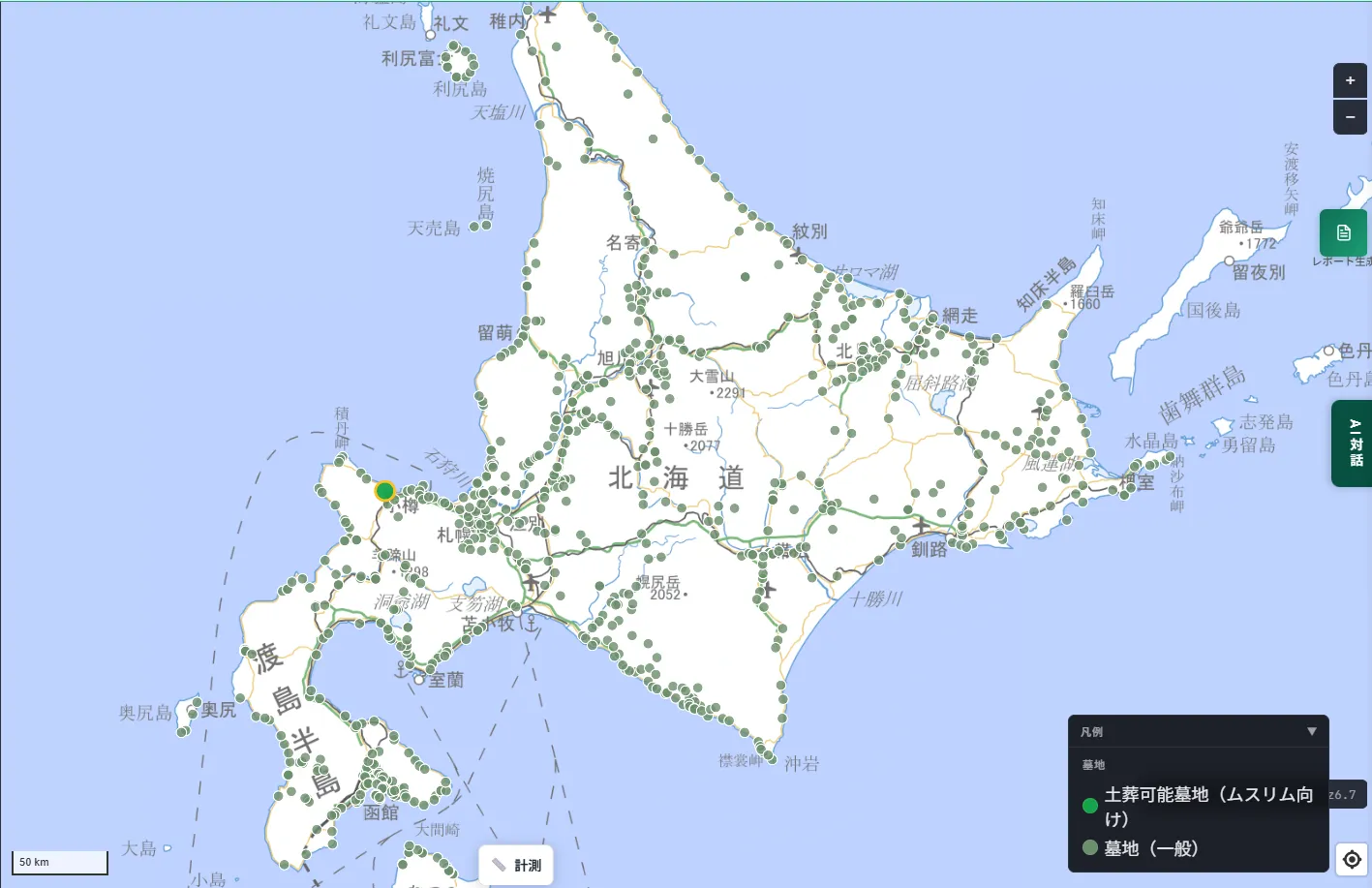
You can see a single burial-accommodating cemetery marker near Otaru City.
Try it: Okinawa and Amami
Here's what it looks like across Okinawa and Amami.
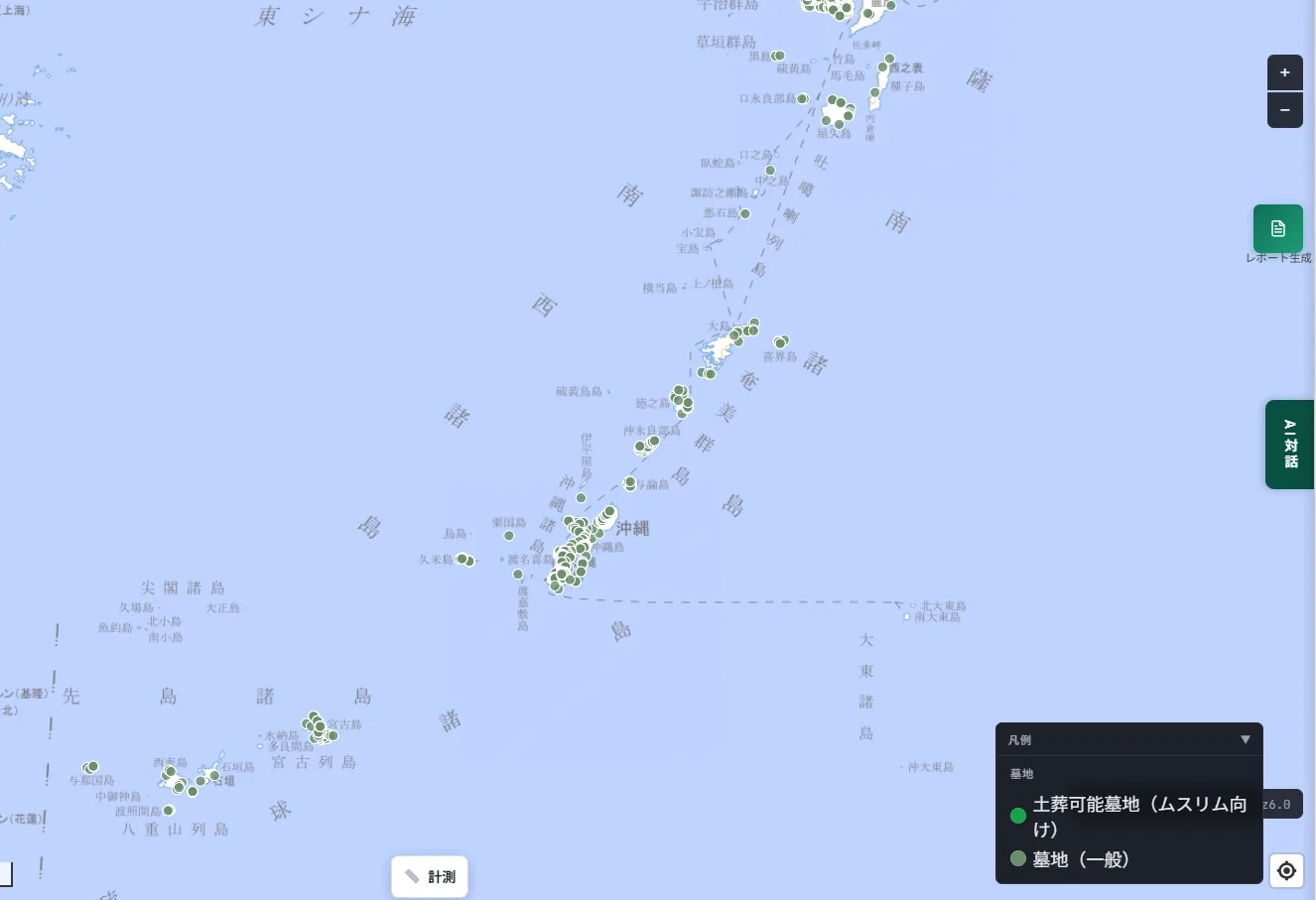
The distribution here is noticeably sparser than in other regions — likely reflecting how thoroughly cemeteries in this area have been registered in OpenStreetMap, rather than an actual scarcity of cemeteries. We'll return to this point below.
How burial practices in Japan have changed
Japan today has a cremation rate of roughly 99.97% (FY2022, Ministry of Health, Labour and Welfare "Report on Public Health Administration and Services") — one of the highest cremation rates in the world. But it wasn't always this way. The cremation rate was around 50% in the 1950s, and it was urbanization, land scarcity, and public-health considerations that drove its rapid spread through the latter half of the 20th century. Going back further, the Meiji government issued a nationwide ban on cremation in 1873, only to reverse it a mere two years later, in 1875, in the face of opposition from the Buddhist establishment and a shortage of burial land.
On the legal side, the Graveyard and Burial Act itself neither mandates cremation nor prohibits burial. What actually restricts burial, in most cases, are ordinances and cemetery management rules set independently by individual municipalities. As a result, burial-accommodating cemeteries remain limited nationwide, and their distribution is geographically uneven.
Looking at this history, it's clear that even within Japan, burial customs haven't been uniform across time and region. In Okinawa and Amami, a distinctive practice known as fūsō ("wind burial") was traditionally passed down, together with a ritual called senkotsu: the body was laid to rest in a cave or tomb to return naturally to the earth, and years later the bones were washed and cleaned before being reinterred. Okinawa Prefecture placed seasonal restrictions on senkotsu for hygiene reasons as early as 1904, cremation was encouraged after the war, and while outdoor fūsō reportedly continued on islands such as Kudaka until the 1960s, cremation became the mainstream practice, as on the mainland, from the 1970s onward.
In recent years, news coverage has increasingly touched on the growing number of Muslims living in Japan who, per their faith, wish to be buried rather than cremated. A handful of burial-accommodating cemeteries already exist in Japan — including the Monjuin Enzan Islamic Cemetery in Koshu City, Yamanashi Prefecture (since the 1960s) and the Osaka Islamic Center Cemetery in Hashimoto City, Wakayama Prefecture (since 2014). Even so, the number of such cemeteries remains limited, and there have been news reports of proposed new burial-accommodating cemeteries running into difficulty building local consensus over the land needed for them, with some plans not proceeding as originally envisioned. Burial customs take many different forms across eras and faiths, and securing the land to accommodate them looks set to remain a real social challenge going forward.
Being upfront about the data's limits
This layer's positions are based on OpenStreetMap contributor data and don't guarantee completeness or accuracy. Name and operator information exists for only about 14% of points; most markers show location only. The burial-accommodating cemetery information is reference information based on individual research and doesn't guarantee that operating conditions haven't changed since it was compiled. Please contact each cemetery or operator directly before relying on this information.
Closing
Whatever era, country, or faith is involved, a grave seems to hold the same basic significance: a place that matters. We hope this layer serves not only as one input into real-estate site selection, but also as a window into the diversity of how people have laid their dead to rest. Our hands are folded in respect.
Questions or feedback are always welcome at info@maprise.jp.
The cemetery data introduced in this post is reference information built from OpenStreetMap (ODbL 1.0). Name and operator information exists for only some points (roughly 14%). Information on Muslim burial-accommodating cemeteries is reference information based on individual research using Wikipedia's "List of Islamic Cemeteries in Japan" and related sources, and does not guarantee current operating status. Please contact each cemetery or operator directly before relying on this information. Cemetery proximity is not a mandatory disclosure item under Japan's Building Lots and Buildings Transaction Business Act. For how this relates to disclosure obligations in a specific transaction, please consult a licensed real-estate transaction specialist or other qualified professional.
Tags: #Cemeteries #Real estate #Open data #Nationwide #Burial practices
Other-language share text (exception cases)
Quick share above follows our platform-locked language policy (X-family in Japanese, LinkedIn in English). The four panes below let you grab the opposite-language body when needed — e.g. introducing an English post to a Japanese audience on X, or posting a Japanese article to LinkedIn in Japanese. Each pane offers both a copy button and a direct intent link.
📝 お墓の位置を地図にしました ― 不動産選びにおける『墓地』という視点
全国の墓地の所在地を示すレイヤーを実装しました。データ概要、不動産選定における『墓地』という視点、そして日本の埋葬のかたちの移り変わりとイスラム教徒向け土葬可能墓地について紹介します。
https://maprise.jp/ja/blog/cemeteries/ #墓地 #不動産
🆕 新しいブログ記事を公開しました。

《お墓の位置を地図にしました ― 不動産選びにおける『墓地』という視点》

全国の墓地の所在地を示すレイヤーを実装しました。データ概要、不動産選定における『墓地』という視点、そして日本の埋葬のかたちの移り変わりとイスラム教徒向け土葬可能墓地について紹介します。

👉 詳しくはこちら: https://maprise.jp/ja/blog/cemeteries/
📝 Cemeteries, Mapped — A New Lens on Real-Estate Site Selection
We've mapped cemetery locations nationwide. Here's the data overview, why cemetery proximity matters as a (non-mandatory) factor in real-estate site selection, and…
https://maprise.jp/en/blog/cemeteries/ #Cemeteries #Realestate
🆕 New on the MAPRISE blog.

《Cemeteries, Mapped — A New Lens on Real-Estate Site Selection》

We've mapped cemetery locations nationwide. Here's the data overview, why cemetery proximity matters as a (non-mandatory) factor in real-estate site selection, and a look at how burial practices in Japan have changed over time — including a small number of dedicated cemeteries that accommodate Muslim burial.

👉 Read the full post: https://maprise.jp/en/blog/cemeteries/

#Cemeteries #Realestate #Opendata #Nationwide #Burialpractices