As a sequel, we look at solar panels on slopes in Kansai and Chukyo (and neighboring Tokai) in MAPRISE's 4-panel view. We also gather, gently, what we found about panel lifespan and replacement timing, the policy at the time mega solar spread, the burden on consumers, and the forests left behind.
Hello, this is the MAPRISE development team. As a sequel to our last article, "Solar panels on slopes and cliff-collapse warning zones in a 4-panel view," we searched Kansai and Chukyo this time. We also gathered what we found about panel lifespan, the policy at the time mega solar spread, and the forests that remain after mountain slopes are cleared.
The second half includes my own thoughts. This is not a criticism of any particular company or facility, but a gentle question: "might there be another way of looking at this?"
We searched Kansai and Chukyo the same way
As before, we matched AI-detected panel areas against steep-slope warning zones (GSI tiles) using the map data. Compared with Kyushu and Kita-Kanto, fewer places matched: two in Kansai and one in Mie. In Aichi and Gifu, nothing matched within this search. Instead, neighboring Shizuoka (Tokai) had a very clear example, so we include it.
Top left is panel detection, top right the aerial photo, bottom left colored elevation, bottom right steep-slope warning zones (yellow = warning, red = special warning).
1. Sakata, Aioi, Hyogo ― panels on a roadside slope
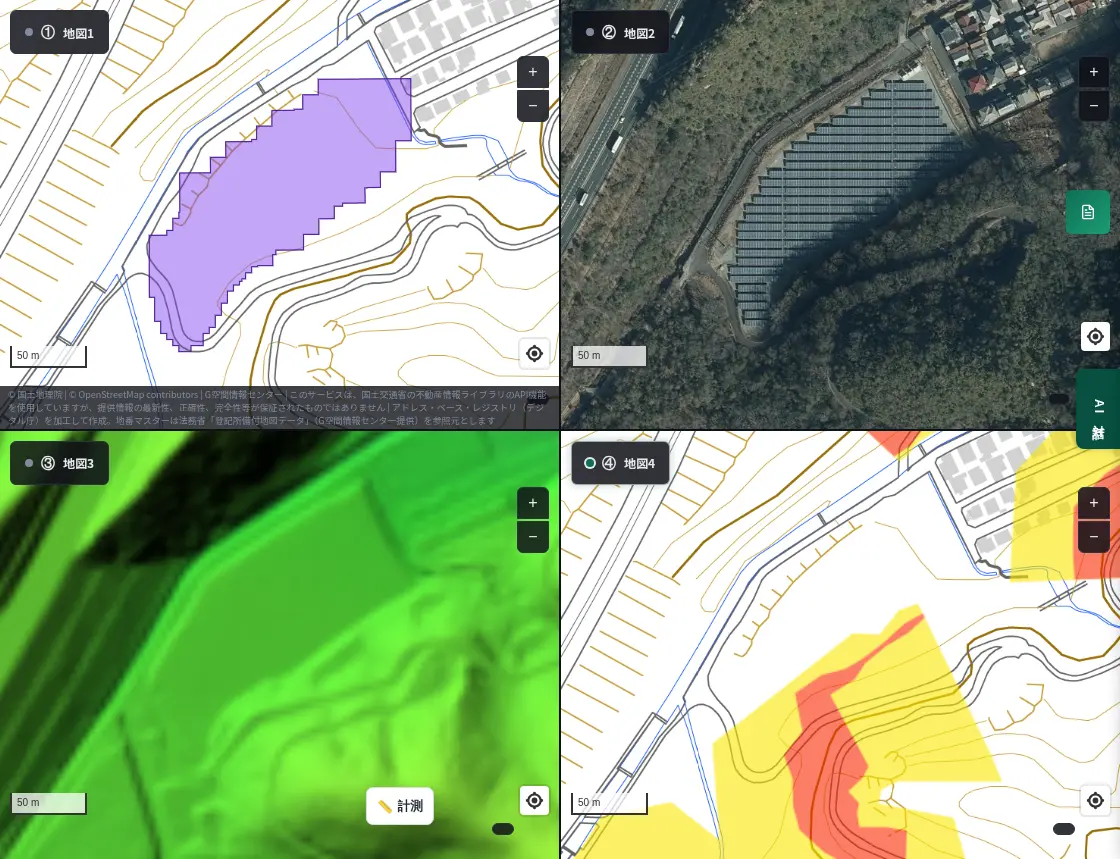
Panels line a slope along a road, with houses visible higher up in the aerial photo. At bottom right, a warning zone overlaps the south (lower) side of the panels.
2. Miyama, Wakayama City ― a huge plant beside a pond
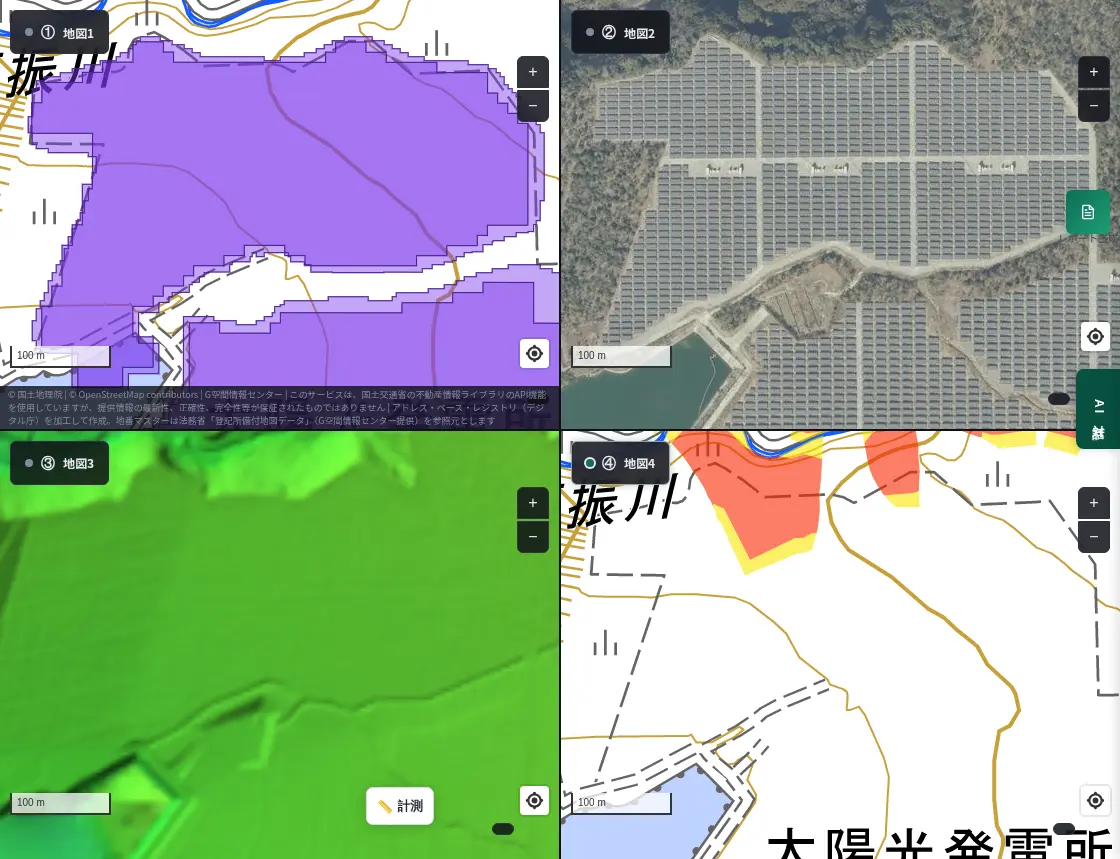
The aerial photo shows countless panels across a wide area beside a pond, and the purple detection area is very large. At bottom right, a warning zone reaches the north edge of the panel area.
3. Kaiya-cho, Yokkaichi, Mie ― panels along a mountain road
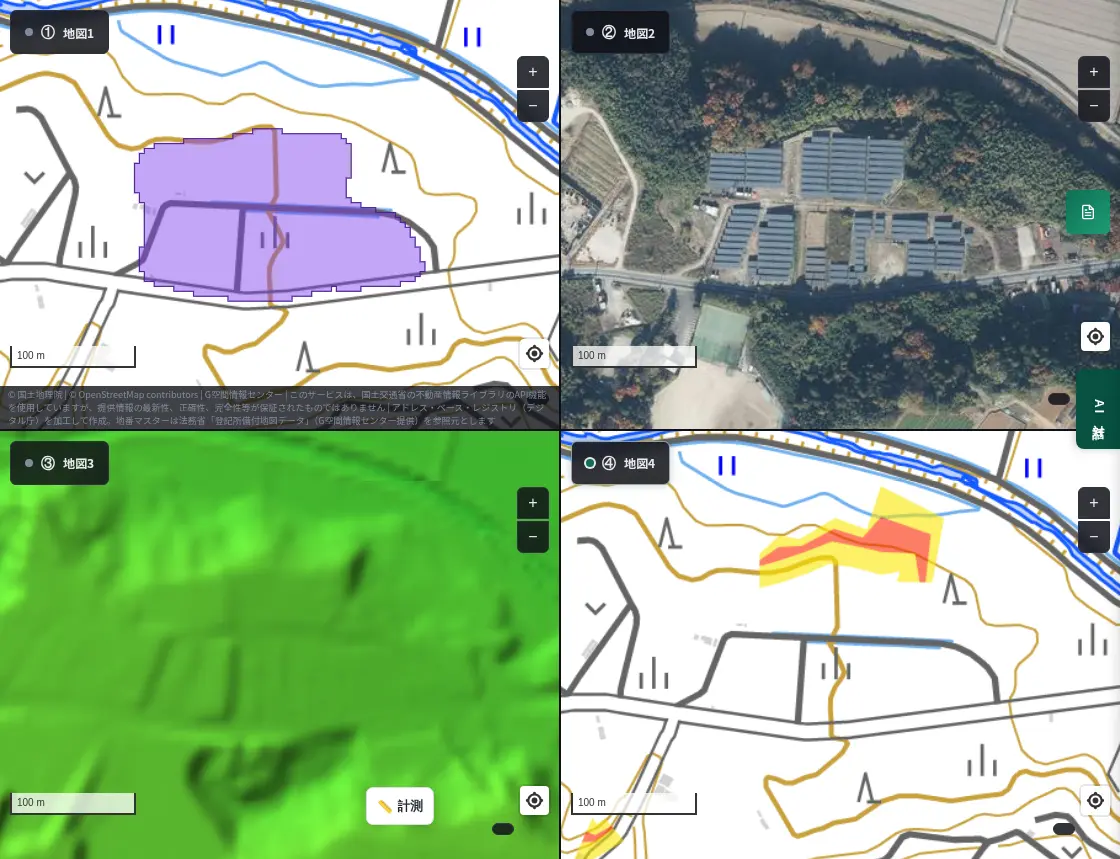
Panels stand in several blocks along a road between hills. A warning zone lies on the slope just north of the panels.
4. Kawahigashi, Kikugawa, Shizuoka (Tokai) ― a large plant beside forest
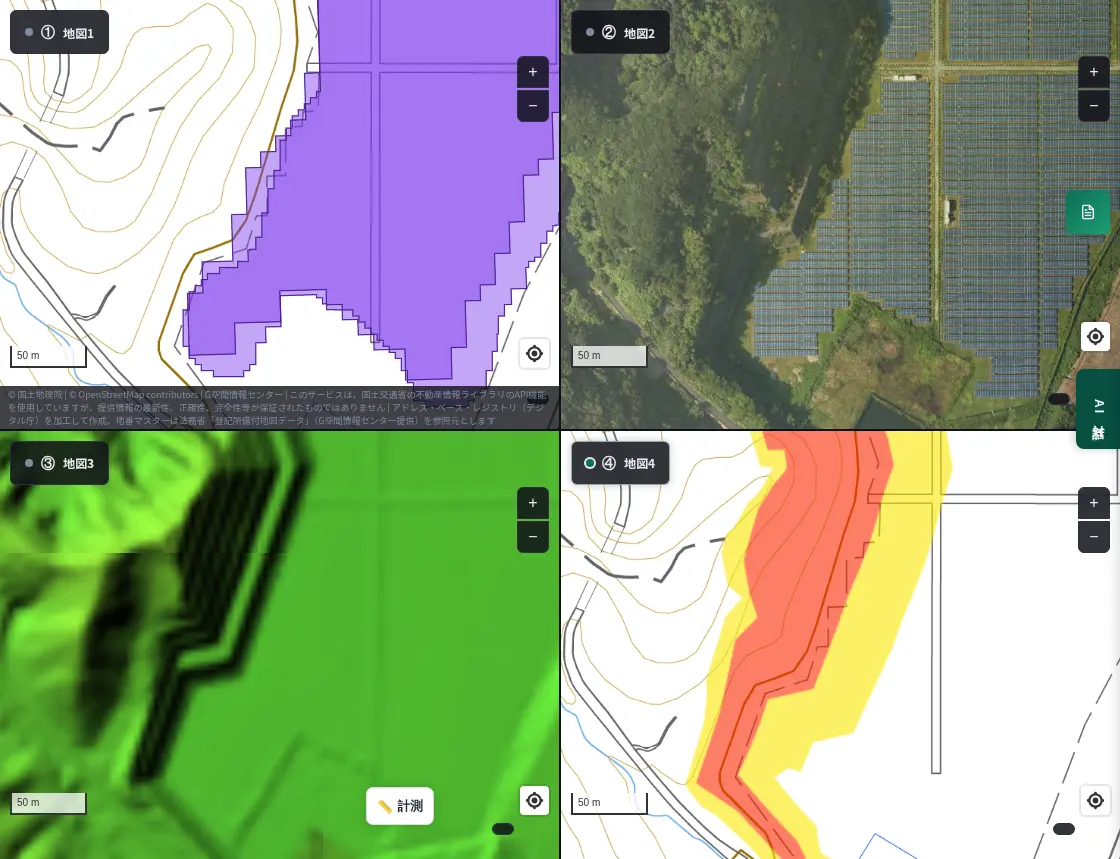
A very wide expanse of panels meets the forest. At bottom right, red and yellow warning zones run in a narrow band along the west edge of the panels. Side by side, the four panels show the relationship between forest, panels, slope and warning zone at a glance.
Panel lifespan and when to replace
How long can these panels last? From what we found:
| Item | Rule of thumb |
|---|---|
| Panel lifespan | About 25–30 years, the basis for manufacturers' output warranties |
| Statutory useful life | 17 years (a tax category, different from real lifespan) |
| Power conditioner | About 10–15 years; shorter than panels, often outside the standard 10-year warranty after that |
| Fixed-price purchase period | 20 years for business use (10 kW and above), 10 years for homes (under 10 kW) |
So the panels themselves may remain usable after the purchase period, but equipment such as power conditioners needs replacing along the way. Broadly, four options are conceivable:
- Replace only the power conditioner and keep using the system
- Replace the panels with new ones (raising output)
- Continue after the purchase period, for example by changing the buyer
- Remove the facility and dispose of or recycle the panels
To prepare for removal and disposal, since July 2022 business operators of 10 kW or more have been required to set aside funds for dismantling in advance. The Ministry of the Environment's estimate is that used panels will rise sharply from the late 2030s to about 500,000–800,000 tons a year. The government has indicated a plan to phase in mandatory recycling, starting with business operators that discharge large volumes.
What it was like when mega solar spread
Behind the spread of mega solar across Japan is the feed-in tariff (FIT), which began in July 2012. Under it, electricity from renewable sources is bought at a price set in advance for a fixed period. In fiscal 2012, business-use solar was bought at 40 yen per kWh for 20 years.
It is sometimes described as "national support," but more precisely it was not paid out of tax revenue; it was a mechanism of buying at a high price for a long time. The cost is carried by everyone through the "renewable energy surcharge" added to electricity bills. That sales income was easy to foresee was probably one reason large-scale installation advanced so quickly.
Has the burden on the public grown?
How has that burden changed? The surcharge per kWh has moved as follows.
| Fiscal year | Surcharge per kWh |
|---|---|
| 2012 | 0.22 yen |
| 2021 | 3.36 yen |
| 2025 | 3.98 yen |
| 2026 | 4.18 yen (record high) |
For fiscal 2026, renewable purchase costs are about 4.85 trillion yen, of which about 3.2 trillion yen is covered by the surcharge. For a standard household using 400 kWh a month, that is about 20,000 yen a year (20,064 yen). The burden is expected to peak around 2032.
On the numbers alone, the burden is larger than when the system began. But some points are worth considering together:
- The surcharge covers all fixed-price renewable energy, including wind and biomass, not only solar.
- More renewables are expected to cut fuel imports and carbon dioxide.
- The early high purchase prices will gradually near their end.
How to weigh "the burden that grew" against "what was gained" differs by person. What matters is knowing the numbers and then thinking about the shape of the future.
Rooftops and building roofs are a good use
I believe solar on building roofs, factory and warehouse roofs, and above parking lots is a very good use, since no new nature needs to be cleared.
The government is also turning in this direction. From fiscal 2027, a policy has been shown not to newly certify ground-mounted business solar of 10 kW or more under FIT/FIP, focusing support on installations that coexist with communities, such as rooftops.
What becomes of the forest after a mountain is cleared?
Still, something concerns us: places that were mountain forest and were cleared on a large scale for mega solar.
According to the Forestry Agency, forest development permits for solar power from fiscal 2013 to fiscal 2020 total about 13,000 cases and about 19,000 hectares. As noted in the last article, concerns about sediment disasters on forested slopes have been raised. In December 2025 the government adopted a countermeasure package for mega solar, and standards for forest development permits under the Forest Act are being reviewed.
What I worry about is this:
- When tariff preferences end and investment and income no longer balance, even if the panels are removed, the cleared forest does not simply return to what it was.
- Forests shelter many animals and plants, and once lost, it takes a very long time for the ecosystem to return.
- The forest's role in storing rainwater may likewise be lost.
Systems to prepare for the future, such as set-aside funds and recycling, are being put in place. Even so, one is reminded that a forest, once lost, takes long and costs much to regain.
The forest environment tax, too
One more thing to recall. From fiscal 2024 the "forest environment tax" began: individuals living in Japan pay 1,000 yen a year (added to resident tax). The money is distributed to municipalities and prefectures as the "forest environment transfer tax" and used for forest management and training the people who do it. The expected revenue is about 6 billion yen a year.
This tax is a system for protecting and nurturing forests nationwide, and was not created to restore forests lost to mega solar. With that said, and as a plain question only, I wonder: if new taxes were to end up funding the restoration of forests cleared for mega solar, would that not be putting the cart before the horse?
When clearing a forest, thinking ahead about how it will be protected and returned seems increasingly important.
Why check it on a map
When thinking about all this, it helps first to see for yourself where panels are and how. MAPRISE's 4-panel view lines up panel detection, aerial photos, elevation and warning zones at the same place. We hope it helps when you research land for real estate, or when terrain catches your eye on a trip. The 4-panel view is available from the Starter plan.
About the data and sources
- Panel areas are AI estimates and may not match actual panel positions.
- Warning zones come from GSI's hazard map tiles. A place without designation is not necessarily safe.
- Figures and policies are as of the time of research (October 2026). Policies are under continued review; please check the latest announcements from the Ministry of Economy, Trade and Industry, the Agency for Natural Resources and Energy, and the Forestry Agency.
- This article introduces how to read the map and the information we found; it does not evaluate any facility or business. My thoughts are personal views.
Questions or feedback are welcome at info@maprise.jp.
Sources
- FY2026 renewable surcharge and rules for ground-mounted solar (SOLAR JOURNAL)
- Tightening of solar rules (mega solar measures, end of FIT/FIP, recycling) (SOLAR JOURNAL)
- FIT purchase price history (PPS-net)
- Countermeasure package for large-scale solar (Cabinet Secretariat)
- Current state and issues of forest development for solar power (Forestry Agency)
- How long do solar panels last? (TEPCO EV DAYS)
- Mandatory set-aside of solar disposal costs (SOLAR JOURNAL)
- Forest environment tax starts in FY2024 (Kadoma City)
- Maps and data: GSI Tiles and hazard map (processed and displayed in MAPRISE; providers and licenses are listed on our Data sources page, and the data you can view on the map on our Layer catalogue)
Tags: #solar power #mega solar #FIT #renewable surcharge #forest environment tax #forests #Kansai #Chukyo #4-panel view
Other-language share text (exception cases)
Quick share above follows our platform-locked language policy (X-family in Japanese, LinkedIn in English). The four panes below let you grab the opposite-language body when needed — e.g. introducing an English post to a Japanese audience on X, or posting a Japanese article to LinkedIn in Japanese. Each pane offers both a copy button and a direct intent link.
📝 太陽光パネルと山林のこれから ― 関西・中京圏の斜面を4分割で見て、寿命・制度・森のことを考える
前回の続きとして、関西・中京圏(と隣接する東海)の斜面に並ぶ太陽光パネルを、4分割表示で見ました。あわせて、パネルの寿命と切り替え時期、メガソーラーが広がった当時の制度、国民負担のこと、そして山林を切り開いたあとの森のことを、調べた範囲でやわらかくまとめました。
https://maprise.jp/ja/blog/solar-panels-kansai-chukyo-forests/ #太陽光発電 #メガソーラー
🆕 新しいブログ記事を公開しました。

《太陽光パネルと山林のこれから ― 関西・中京圏の斜面を4分割で見て、寿命・制度・森のことを考える》

前回の続きとして、関西・中京圏(と隣接する東海)の斜面に並ぶ太陽光パネルを、4分割表示で見ました。あわせて、パネルの寿命と切り替え時期、メガソーラーが広がった当時の制度、国民負担のこと、そして山林を切り開いたあとの森のことを、調べた範囲でやわらかくまとめました。

👉 詳しくはこちら: https://maprise.jp/ja/blog/solar-panels-kansai-chukyo-forests/

#FIT
📝 Solar Panels and the Future of Mountain Forests ― Kansai and Chukyo in a 4-Panel View, and Thoughts on Lifespan, Policy and Forests
As a sequel, we look at solar panels on slopes in Kansai and Chukyo (and neighboring Tokai) in…
https://maprise.jp/en/blog/solar-panels-kansai-chukyo-forests/ #solarpower #megasolar
🆕 New on the MAPRISE blog.

《Solar Panels and the Future of Mountain Forests ― Kansai and Chukyo in a 4-Panel View, and Thoughts on Lifespan, Policy and Forests》

As a sequel, we look at solar panels on slopes in Kansai and Chukyo (and neighboring Tokai) in MAPRISE's 4-panel view. We also gather, gently, what we found about panel lifespan and replacement timing, the policy at the time mega solar spread, the burden on consumers, and the forests left behind.

👉 Read the full post: https://maprise.jp/en/blog/solar-panels-kansai-chukyo-forests/

#solarpower #megasolar #FIT #renewablesurcharge #forestenvironmenttax
Related posts
- Solar Panels on Former Golf Courses ― How Many Have Closed, and Seven Places in Japan in a 4-Panel View2026-10-03
- Is that electricity worth a mountainside? — Mega-solar in the hills, and the cost the map reveals2026-06-07
- Don't Choose a Cliff-Top Home on View and Elevation Alone: Retaining Walls, Disclosure Rules, Land Prices and Yellow Zones, City by City (Part 2)2026-10-25