Whether city gas can be piped to a site affects both construction cost and residents' monthly bills. Here is how to check each operator's service area and contact on MAPRISE's city gas layer while you are still evaluating land.
Hello from the MAPRISE development team.
When planning a building, "does city gas reach this site?" is easy to leave for later. Yet choosing between a city gas connection and propane (LP gas) affects both construction cost and residents' monthly bills. This article explains what MAPRISE's city gas service area layer shows, and why operators and developers may find it useful.
Key points
- City gas and propane differ in price, upfront cost and behavior in disasters. Which one is better depends on the site and the intended residents.
- The layer shows which city gas operator serves each municipality across Japan, and clicking a municipality shows the operator name and a link to its website (the entry point for inquiries).
- A practical approach is to use it for a first screening while evaluating land, then confirm exact availability with the listed operator.
City gas vs propane ― the basics
The table below describes general tendencies. Prices and conditions vary widely by operator, region and contract.
| Aspect | City gas | Propane (LP gas) |
|---|---|---|
| Supply | Piped through underground mains | Cylinders installed per unit or per building and delivered |
| Upfront cost | Needs a service connection from the main; varies with distance and road conditions | Mainly storage equipment; no pipe work |
| Price tendency | Said to be relatively stable | Set by each seller, so differences between sellers are said to be large |
| In a disaster | The whole network must be safety-checked, so restoration can take time | Equipment can be inspected unit by unit; restoration tends to be quicker |
| Where available | Only inside the pipe network | In principle, anywhere |
Propane's strength: independence in a disaster
Propane is a distributed system: each home holds its own cylinders. It does not depend on a pipe network, so after wide-area damage it can often be used again sooner once the equipment is checked. Government materials on the Great East Japan Earthquake describe LP gas as being restored faster than city gas. For buildings that want a heat source that stays usable in emergencies, this is a real advantage.
Propane's weakness: higher running costs
On the other hand, propane tends to cost more than city gas, and some sources point out that it can be more than double depending on the operator and area. Residents will notice this, especially in households that use a lot of hot water, where gas for water heating, space heating and cooking adds up. For a single resident who barely uses hot water the gap is small; for family units it can matter over years.
The developer's dilemma
- If city gas can be connected: there is a connection cost, but residents' gas bills are easier to keep down, which can help leasing.
- If the main is far away: the connection cost can be large. Choosing propane lowers initial cost but may burden residents.
- If disaster resilience is part of the value proposition, choosing propane's independence can be a deliberate decision.
Judging early whether city gas is available, and at what cost, therefore affects project profitability and resident satisfaction. The starting point is knowing which operator serves the area.
What the city gas service area layer shows
The layer shades each municipality by the city gas operator whose service area includes it, based on each operator's published terms of service and service-area maps.
- Researched from public materials of 189 general gas pipeline operators nationwide (as of October 2026)
- 1,898 municipalities in three categories:
- Service area present (colored by operator): 857
- Unconfirmed (an operator exists): 4
- No operator: 1,037
- Clicking the map shows the operator name and a link to its website
The layer started with seven Kyushu prefectures and is now nationwide. The background and design decisions are in Water Could Not Be Mapped. City Gas Could.
Wide-area views: who serves where
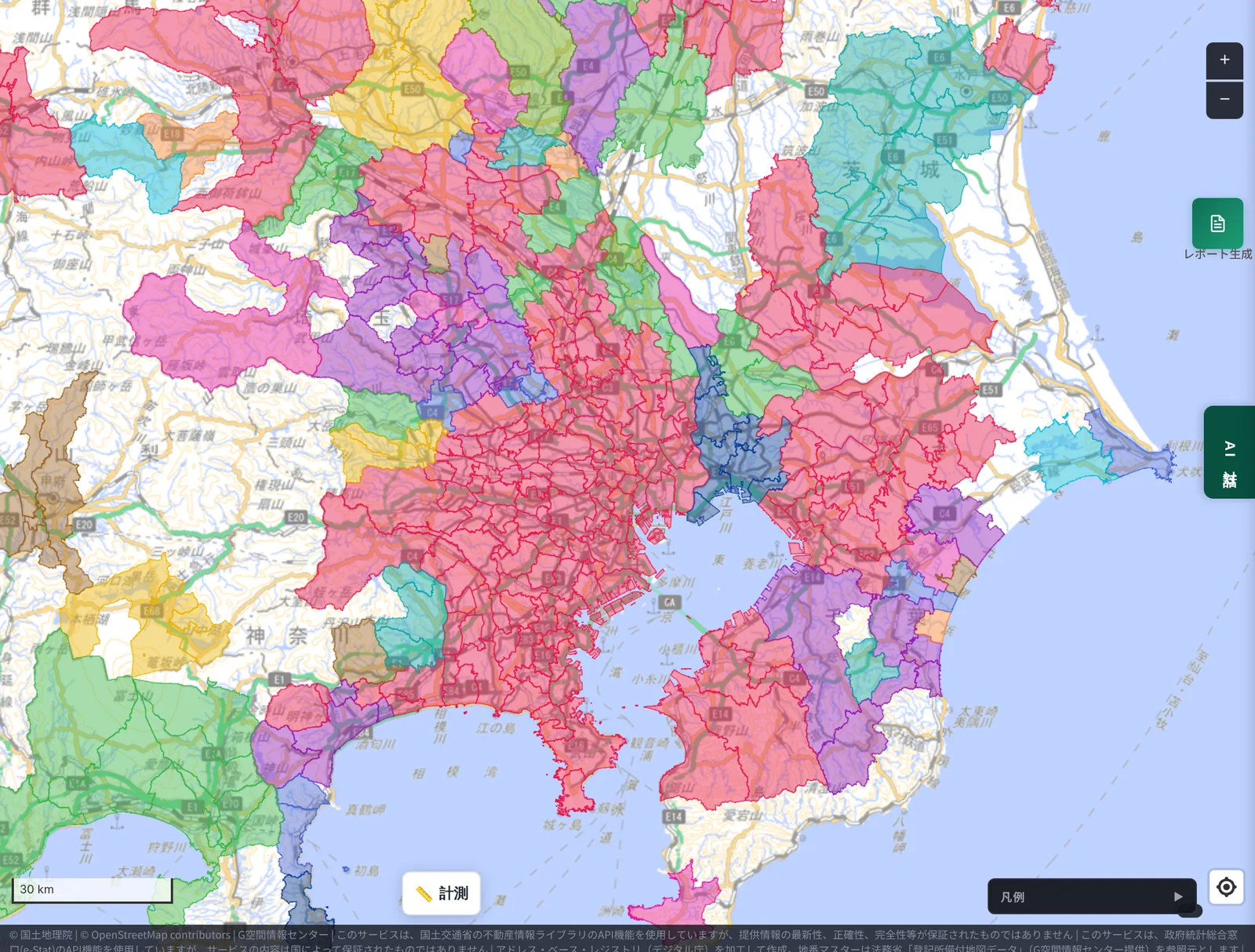
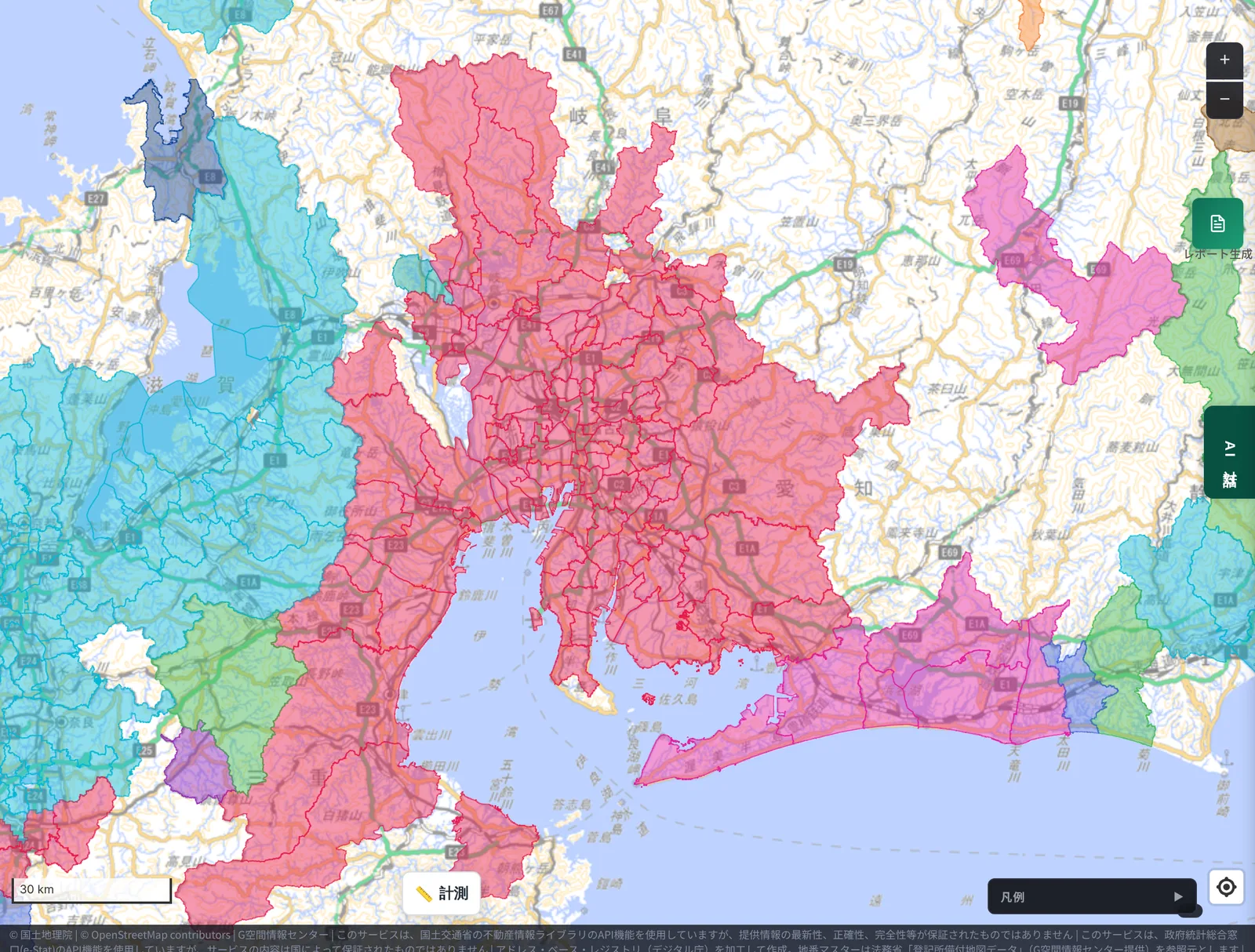
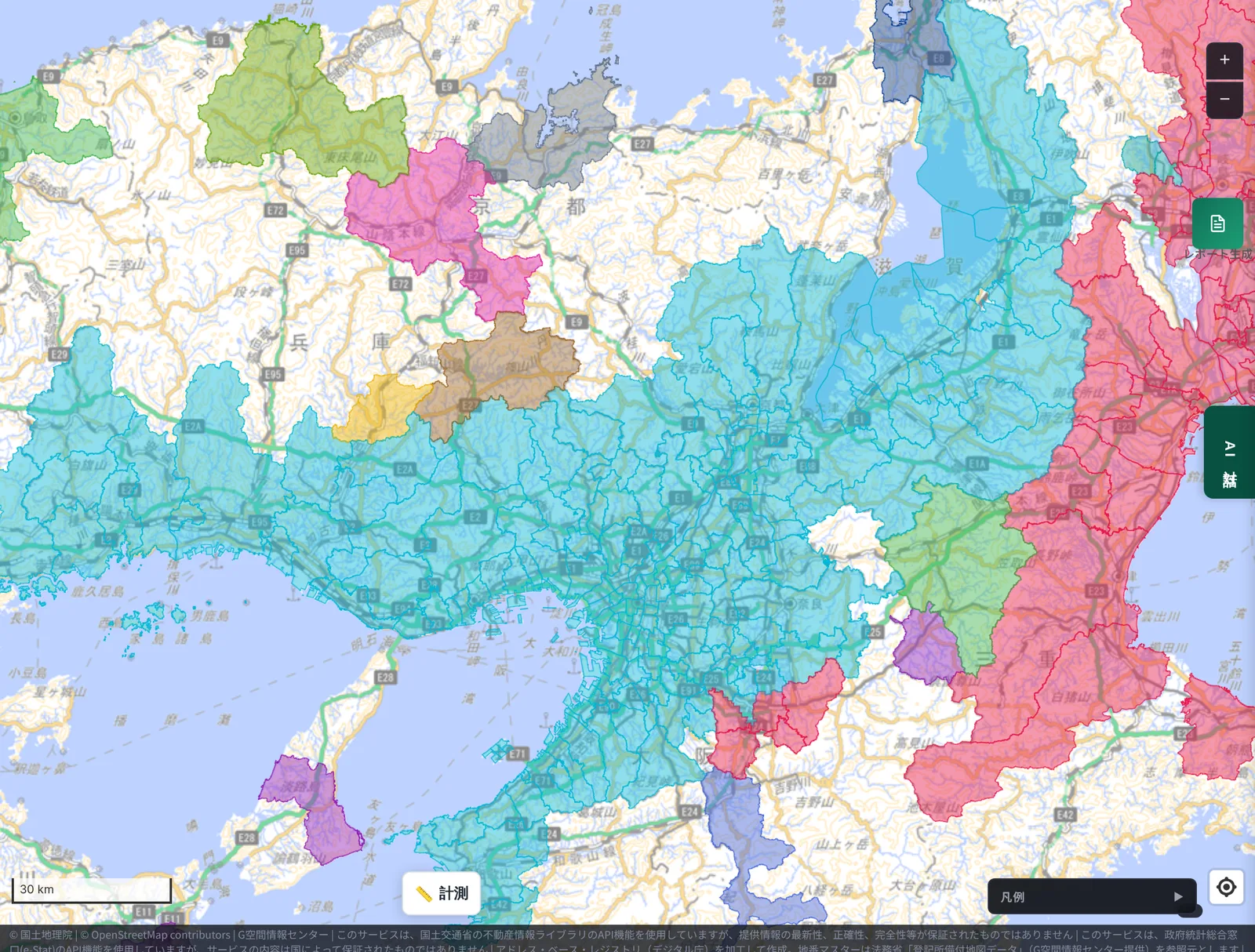
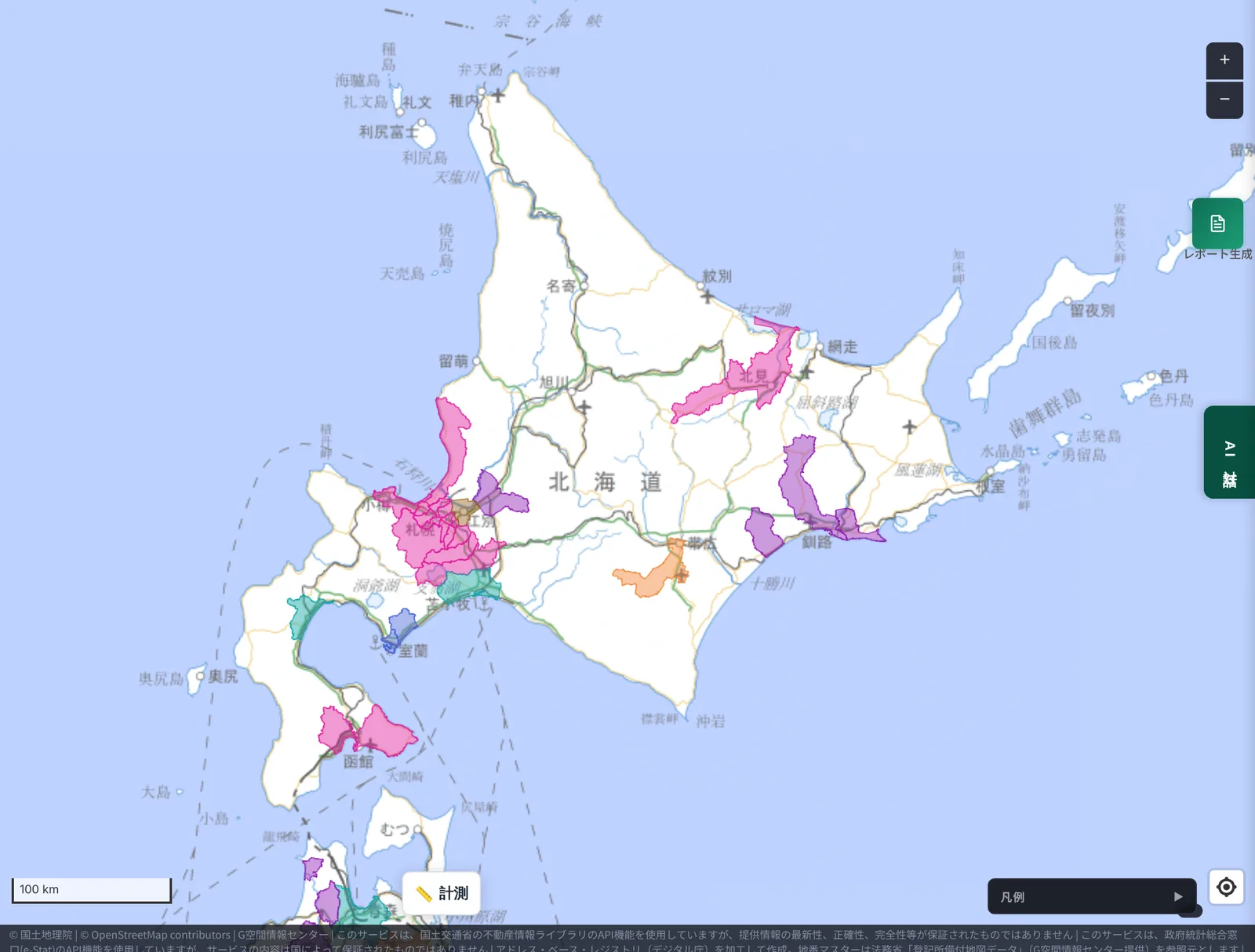
Seen nationwide, city gas concentrates in large metropolitan areas, and blocks of color show each operator's territory. In rural regions, service appears scattered around urban centers. Here is how it looks in each region.
Greater Tokyo
In Greater Tokyo, Tokyo Gas Network (red) dominates around Tokyo Bay and extends into Kanagawa, Saitama and Chiba, with many other operators' areas surrounding it.
Chukyo (Nagoya) area
In the Chukyo area, Toho Gas Network's territory (red) spreads from Nagoya across Aichi into Gifu and Mie, with other operators further east.
Kinki (Osaka–Kyoto–Kobe)
In Kinki, one large light-blue area runs unbroken from Osaka Bay to Kyoto, Shiga and Nara, while other operators appear in northern Hyogo, Awaji Island and elsewhere.
Hokkaido
In Hokkaido, areas are scattered around Sapporo and a few cities in the east and south of the island; most of the island lies outside any area, so planning with propane will often be the premise.
Kyushu
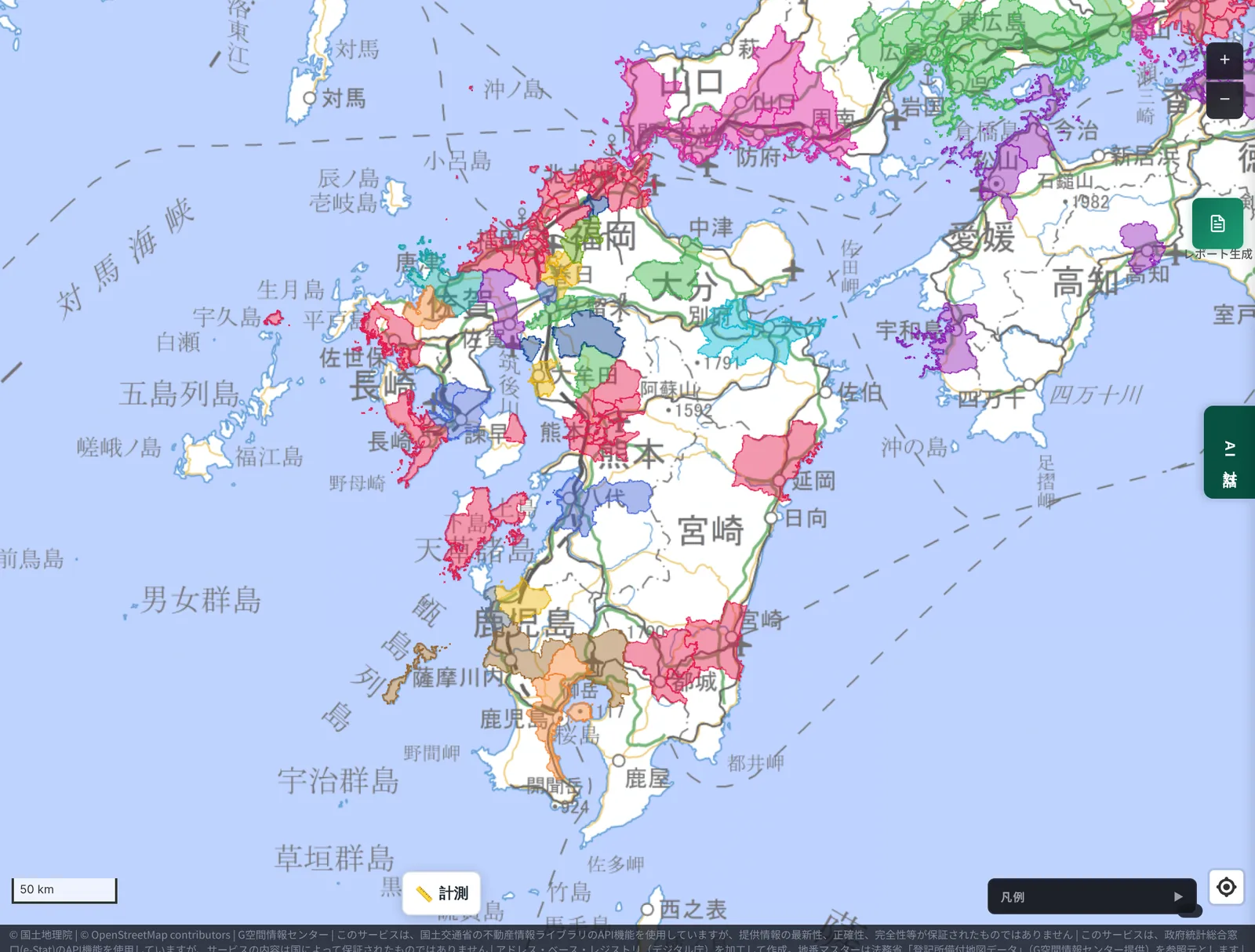
In Kyushu, areas cluster around urban centers such as Fukuoka, Kitakyushu, Nagasaki, Kumamoto and Kagoshima, and remain sparse inland and on islands.
What appears when you click
Clicking a municipality first opens a list ("This point has N items"); choose the city gas row and "Show details" to open the detail view. The image below shows Komaki City, Aichi.
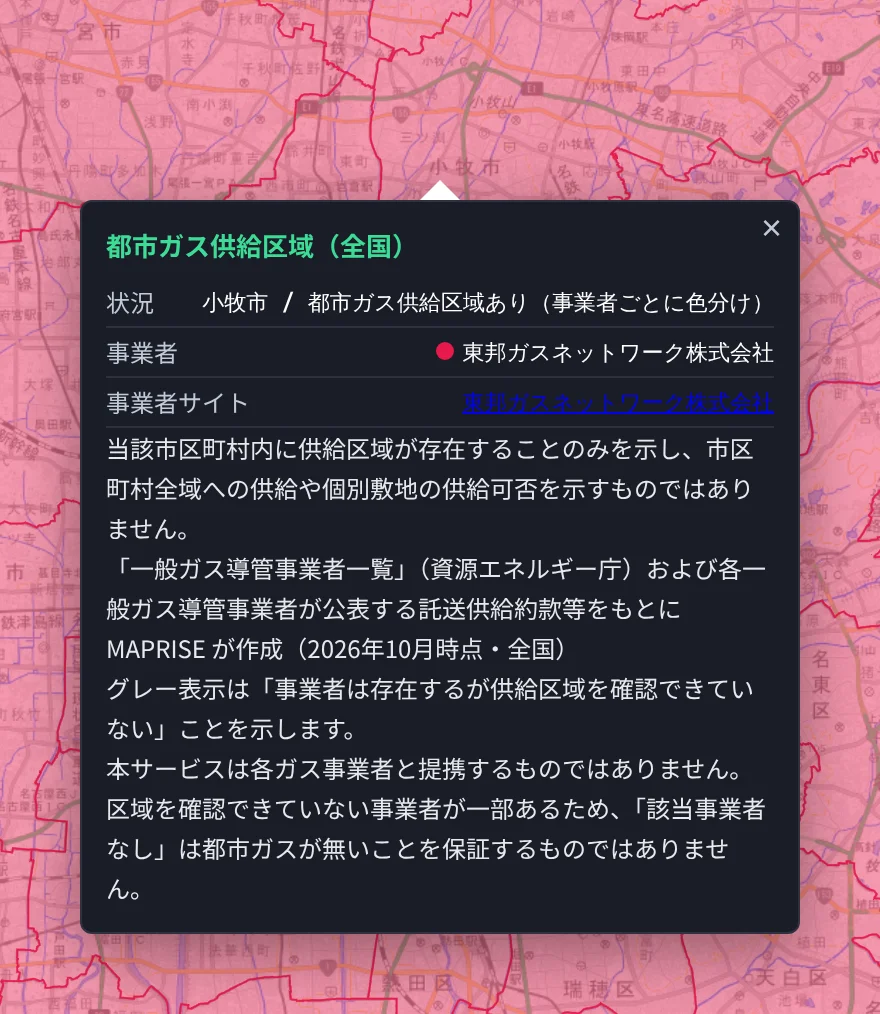
The detail view shows mainly:
- The municipality's supply status (service area present / unconfirmed / no operator)
- The gas operator name
- A link to the operator's website (where to inquire)
- Remarks on the supply range in the terms of service, where available
- The source, and a note that this is a municipality-level overview
Knowing exactly whom to ask is a small but real time-saver.
Caution: the layer is a municipality-level overview. Many operators limit supply to specific districts within a municipality, so it cannot show whether a pipe reaches an individual site. The service areas of 6 operators could not be confirmed, so "no operator" does not guarantee that city gas is unavailable. Confirm exact availability directly with the listed operator.
Why operators and developers benefit
- Faster first screening of sites. Sort candidates into "city gas likely" and "propane likely" before making calls, and narrow down whom to contact.
- Operator links at a glance. You can save time searching for each operator's service-area map and jurisdiction, especially in developments spanning several municipalities.
- Earlier assumptions for financial models. City gas vs propane changes construction cost and residents' monthly burden; setting the assumption early reduces rework.
- Overlay with other layers. Combine hazard, zoning, school districts and water utility layers, and decide the utility policy within an overall site assessment.
- Groundwork for property disclosure. Real-estate transactions require explaining utilities. The layer is reference information and does not satisfy requirements by itself, but it helps identify whom to confirm with.
How to use it
- Open MAPRISE and turn on City Gas Service Area (Nationwide, by operator) in the living-facilities group of the layer menu.
- Pan and zoom to your target area.
- Click a municipality to see status, operator name and operator website.
- Ask the operator about availability and connection conditions for the specific site.
The layer is available on the Starter plan or above.
Closing
City gas or propane is not a question of which is better, but of which fits the site and the residents. As a first step, we hope the map helps you see which operator serves the area.
Questions and feedback are welcome at info@maprise.jp.
City gas service-area data is reference information researched by MAPRISE from operators' published terms of service and service-area maps (as of October 2026). Statements on price and restoration describe general tendencies and are not guarantees for any specific case.
External sources consulted
- Materials on LP gas and city gas restoration in disasters (Agency for Natural Resources and Energy): https://www.meti.go.jp/shingikai/enecho/shigen_nenryo/sekiyu_gas/ekika_sekiyu/pdf/004_04_00.pdf
- Pros and cons of LP gas (Selectra): https://selectra.jp/lpgas/guides/knowledge/lpgas-pro-con
- LP gas industry trends (Mizuho Bank Industry Research): https://www.mizuhobank.co.jp/corporate/industry/pdf/msif_237.pdf
Tags: #city gas #propane #LP gas #gas operator #service area #developer #land acquisition #disaster preparedness #property disclosure
Other-language share text (exception cases)
Quick share above follows our platform-locked language policy (X-family in Japanese, LinkedIn in English). The four panes below let you grab the opposite-language body when needed — e.g. introducing an English post to a Japanese audience on X, or posting a Japanese article to LinkedIn in Japanese. Each pane offers both a copy button and a direct intent link.
📝 都市ガスかプロパンか、土地を見る段階で決まる ― 供給事業者の対応地域と事業者サイトを、全国の地図で確認する
建物を建てるとき、都市ガスを引けるかどうかは、建築コストと入居者の月々の負担の両方を左右します。MAPRISEの都市ガス供給区域レイヤーで、全国の事業者の対応地域と連絡先を、用地の検討段階で確認する方法をまとめました。
https://maprise.jp/ja/blog/city-gas-layer-developer-guide/ #都市ガス #プロパンガス
🆕 新しいブログ記事を公開しました。

《都市ガスかプロパンか、土地を見る段階で決まる ― 供給事業者の対応地域と事業者サイトを、全国の地図で確認する》

建物を建てるとき、都市ガスを引けるかどうかは、建築コストと入居者の月々の負担の両方を左右します。MAPRISEの都市ガス供給区域レイヤーで、全国の事業者の対応地域と連絡先を、用地の検討段階で確認する方法をまとめました。

👉 詳しくはこちら: https://maprise.jp/ja/blog/city-gas-layer-developer-guide/
📝 City Gas or Propane? It Starts at the Land-Selection Stage ― Checking Gas Operators' Service Areas and Websites on a Nationwide Map
Whether city gas can be piped to a site affects both construction cost and residents' monthly bills…
https://maprise.jp/en/blog/city-gas-layer-developer-guide/ #citygas #propane
🆕 New on the MAPRISE blog.

《City Gas or Propane? It Starts at the Land-Selection Stage ― Checking Gas Operators' Service Areas and Websites on a Nationwide Map》

Whether city gas can be piped to a site affects both construction cost and residents' monthly bills. Here is how to check each operator's service area and contact on MAPRISE's city gas layer while you are still evaluating land.

👉 Read the full post: https://maprise.jp/en/blog/city-gas-layer-developer-guide/

#citygas #propane #LPgas #gasoperator #servicearea
Related posts
- Closed Lines Have Histories Too — Tracing Coal, Factory and Streetcar Lines on a Four-Panel Map2026-10-15
- Japan's Calderas in Black-and-White Hillshade and Colored Elevation ― Aso, Mashu, Toya, Hakone and More2026-10-03
- Solar Panels on Slopes and Cliff-Collapse Warning Zones in a 4-Panel View ― Places to Watch in Heavy Rain2026-10-03