Minpaku (private lodging) arranged through a smartphone widened the choice of places to stay, but it also led to regulations across Japan. Using MAPRISE's layer that color-codes minpaku ordinances by municipality, we look at Hyogo, where every municipality is strict, Tokyo's 23 wards, where rules differ ward by ward, and Osaka, where special-zone minpaku is mixed in.
Hello from the MAPRISE team.
This post introduces MAPRISE's "Minpaku Ordinances (by Municipality)" layer. It is a layer in which we research ordinances and other public information on minpaku (private lodging) for each municipality and color-code them on the map.
Minpaku widened the choice of places to stay
Alongside global companies such as Airbnb, a number of minpaku information services have appeared that connect hosts and guests through their smartphones. People who own a house or a room can rent out an asset they aren't using to someone else for a limited time. For guests, it is often cheaper than a hotel or in a location that is more convenient for sightseeing, and the choice of places to stay has widened a lot.
I have used minpaku myself. There were thoughtful touches you don't find in an ordinary hotel, I could cook for myself if I wanted to, and the place was right next to the station. It was very convenient.
Meanwhile, regulations appeared across Japan
At the same time, the sudden rise in minpaku brought many problems. In an apartment building where only familiar faces used to come and go, strangers with large suitcases started coming and going almost every day. If their manners were poor, there could be loud noise late at night. In response, regulations were introduced in many places.
At the national level, the Private Lodging Business Act (the so-called Minpaku Act) took effect in 2018 and capped minpaku operation at 180 days a year. On top of that, many local governments enacted ordinances that add further restrictions by area, day of the week or period. Some places are lenient, some strict, and many in between.
Local ordinances are amended often, so this is a fast-changing field. Even so, we wanted to keep track of this information, put it on a map and make it easy to see what applies where. That is why we built this layer.
How to read the layer
When you turn on "Minpaku Ordinances (by Municipality)" in the map app, a color-coded dot appears at the approximate center of each of Japan's 1,741 municipalities. The colors mean the following:
- Pale yellow: no additional ordinance confirmed (we found no extra restriction by ordinance; the national 180-day rule still applies)
- Orange: partly restricted by ordinance (rules on days of the week, periods, areas near schools, etc.)
- Dark red: strictly restricted by ordinance (there are areas where minpaku is not allowed all year, or areas limited to about 60 days a year or fewer)
- Blue: special-zone minpaku (minpaku under the National Strategic Special Zones system, separate from the Minpaku Act)
- Grey: not yet confirmed (no color does not mean no restriction)
The color reflects the strictest area within the municipality, and rules can differ by location inside it.
Looking across Japan
First, here is all of Japan.
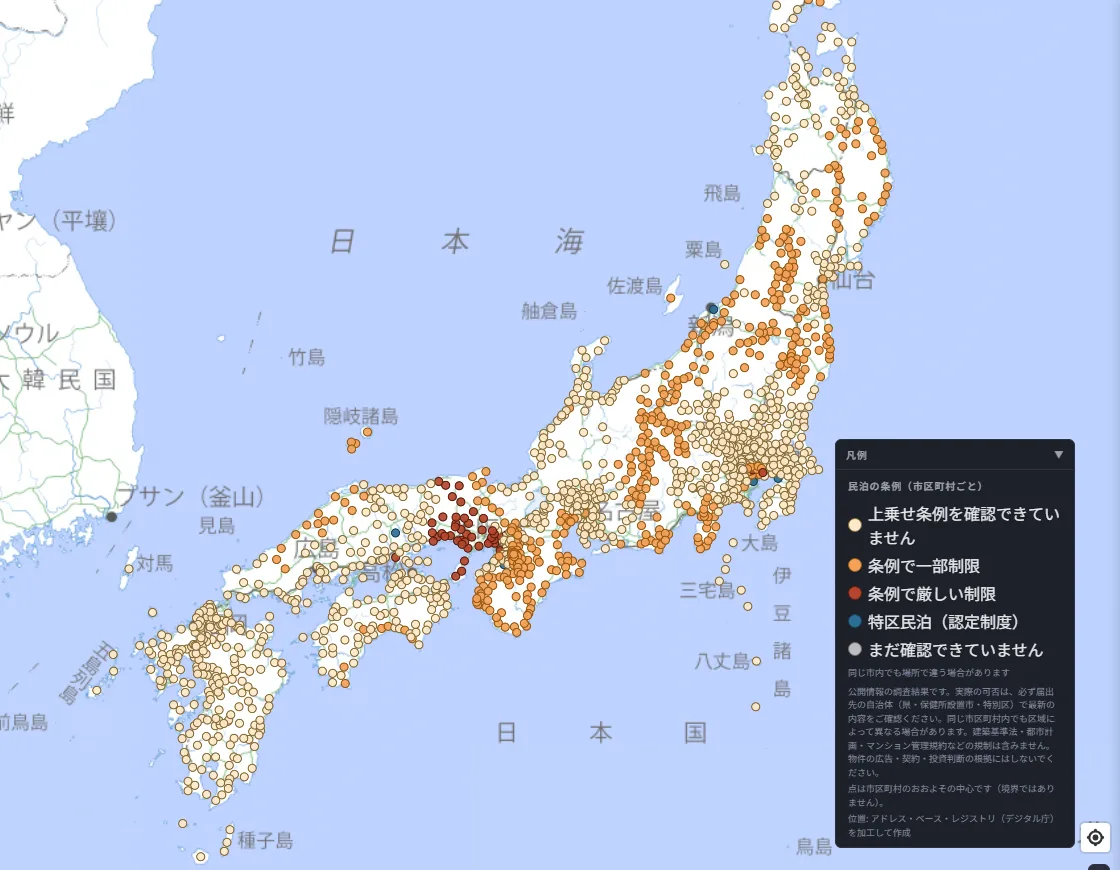
The cluster of dark red dots in part of Kinki stands out. Tohoku, Chubu and Kanto have many orange dots, while Kyushu, Chugoku and other regions have many pale yellow dots. Even under the same national rule, the approach to additional regulation varies considerably by region.
A strict area: Hyogo Prefecture
The cluster of dark red is Hyogo Prefecture.
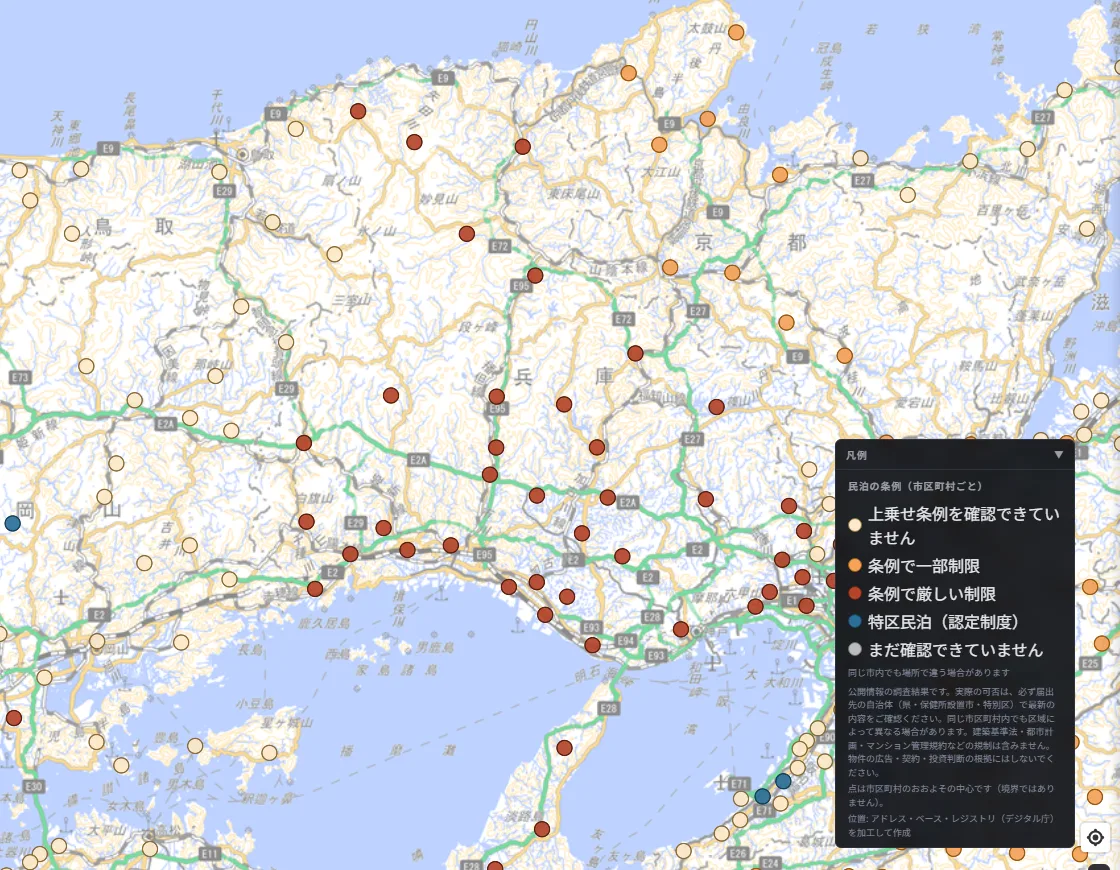
In Hyogo, all 41 municipalities, from the Sea of Japan coast to the Seto Inland Sea coast and Awaji Island, are classed as "strictly restricted by ordinance". Many of the municipal summaries say that minpaku is not allowed at any time of year in exclusively residential zones and near schools, and not on weekends, in summer or in winter in parks and scenic areas. Compared with neighboring Okayama and Tottori, the color changes sharply at the prefectural border.
Clicking a dot shows the municipality's class, a summary and the check date. Here is Ashiya, for example.
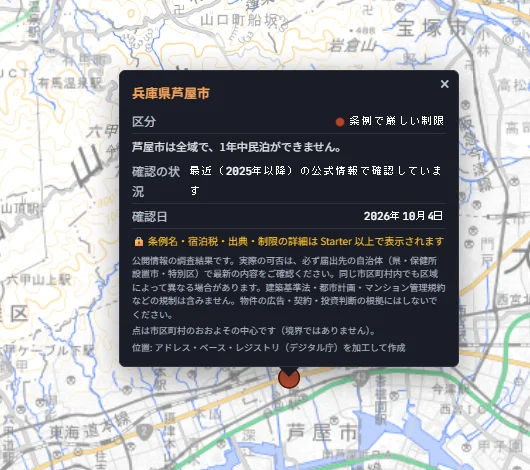
Ashiya is summarized as not allowing minpaku anywhere in the city at any time of year. Ordinance names, sources and detailed restrictions are shown on the Starter plan and above.
A patchwork area: Tokyo's 23 wards
Next is Tokyo's 23 wards.
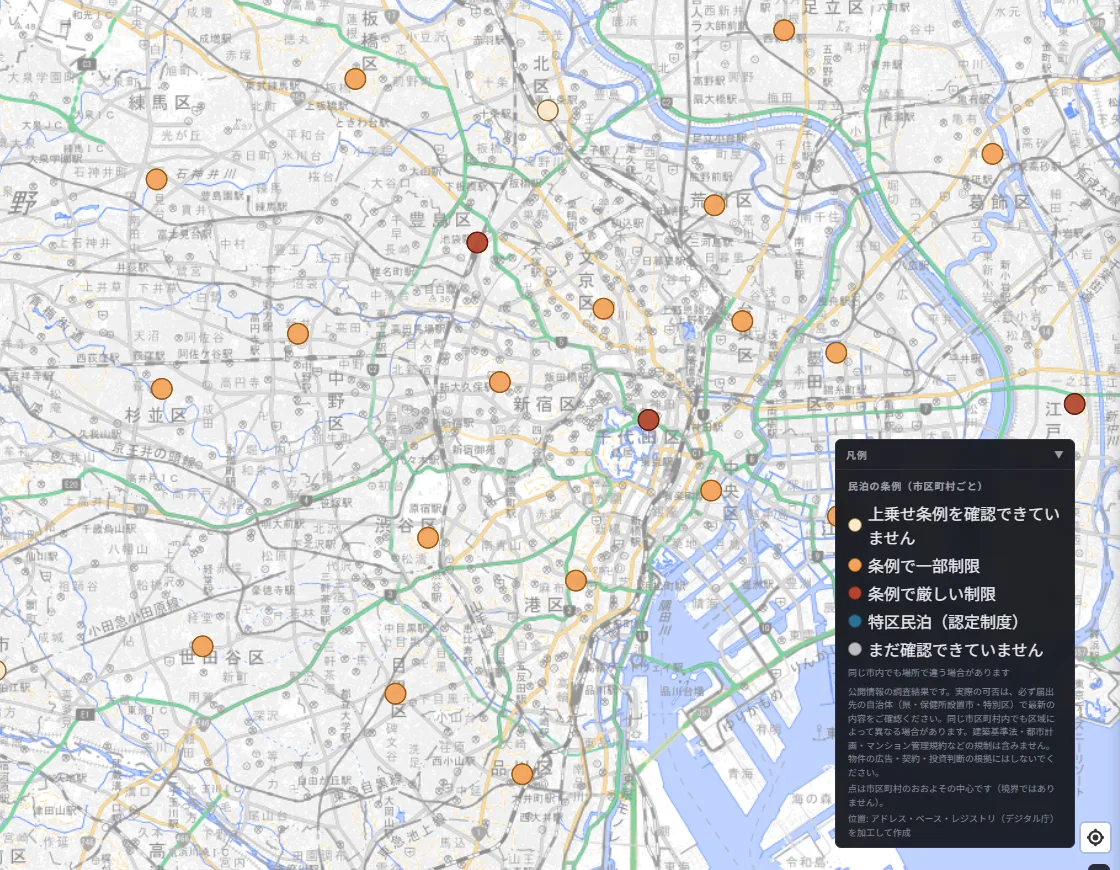
Most of the 23 wards are orange, but Chiyoda, Toshima and Edogawa are dark red, Kita is pale yellow, and Ota (outside this view, to the south) is blue for special-zone minpaku. Even neighboring wards have different colors.
The same orange covers quite different rules from ward to ward. Picking out some of the ward summaries:
- Chuo and Koto: throughout the ward, minpaku is allowed only on weekends (Saturday noon to Monday noon; Koto also on public holidays)
- Meguro: throughout the ward, only from Friday noon to Sunday noon
- Shinjuku and Nerima: not on weekdays (Monday noon to Friday noon) in exclusively residential zones
- Shibuya: only about 63 days a year in residential zones
- Taito: minpaku notified on or after October 1, 2026 is allowed only on weekends, public holidays and the New Year period
Each ward defines the target areas, days of the week and periods differently. The patchwork you see on the map reflects these differences.
A patchwork area: Osaka and special-zone minpaku
Osaka Prefecture is another patchwork.
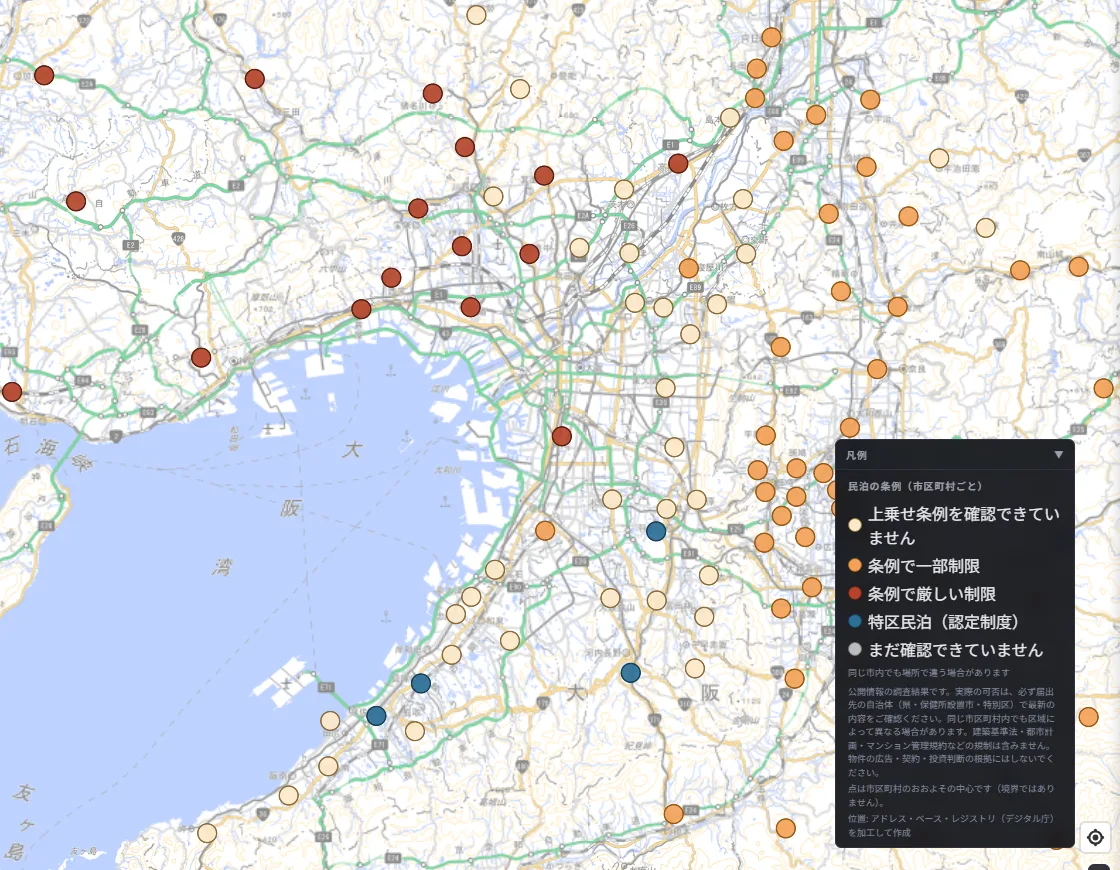
Osaka City, Takatsuki, Minoh and Toyonaka are dark red; Neyagawa and Sakai are orange; Izumisano, Kaizuka, Habikino and Kawachinagano are blue for special-zone minpaku; and most other municipalities are pale yellow.
Osaka has also hosted special-zone minpaku under the National Strategic Special Zones system. Special-zone minpaku requires stays of at least two nights and three days and is a separate system from Minpaku Act lodging. Cities with lenient and strict Minpaku Act ordinances sit next to special-zone cities, so the situation varies a lot within the prefecture.
Seasonal rules in tourist areas: Nagano and beyond
Finally, the Chubu region centered on Nagano Prefecture.
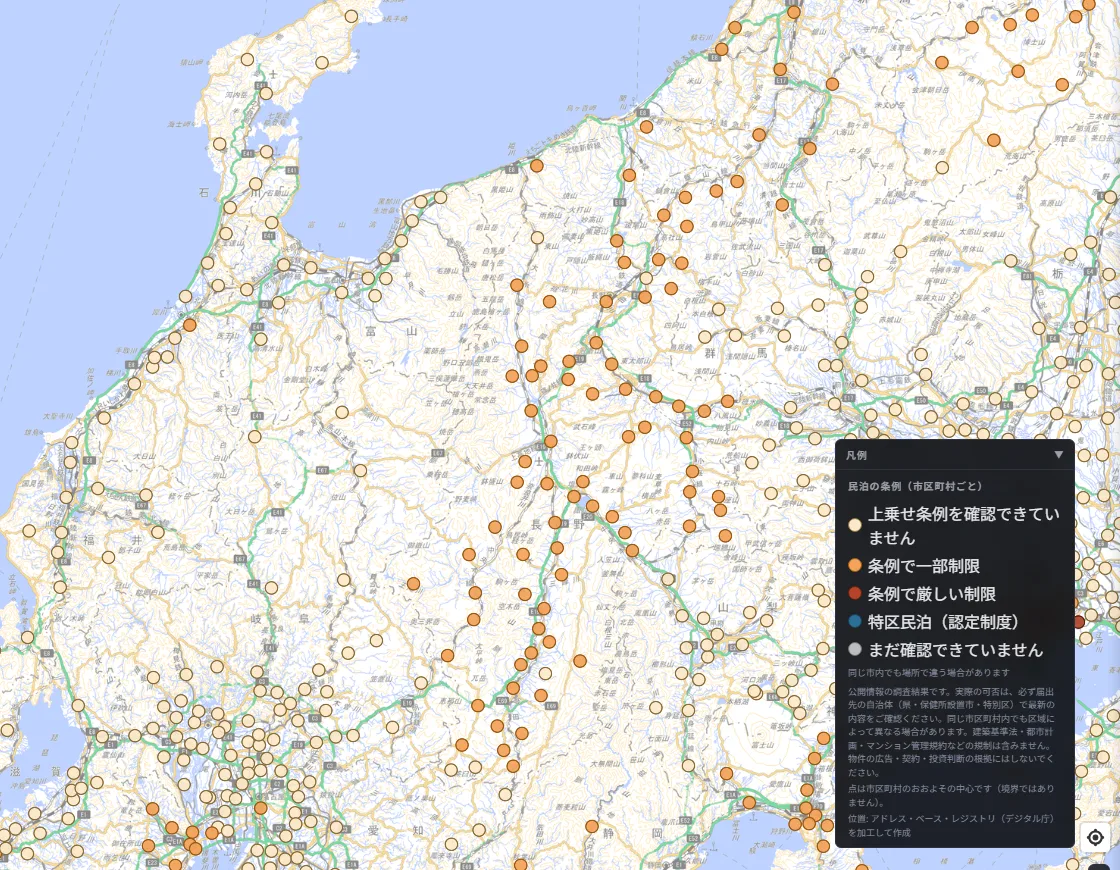
Many dots in Nagano and nearby prefectures are orange. In Nagano, a prefectural ordinance restricts minpaku by period and area. For example, Hakuba is summarized as not allowing host-absent minpaku around the ski areas in winter (December to March), and Karuizawa as not allowing it in May and from July to September under the prefectural ordinance, with the town's policy being not to accept minpaku. Some areas set their rules around the peak tourist seasons.
For hosts and guests alike
Running a minpaku is not all upside either. I hear of guests who take the amenities home with them, or who leave the place in a terrible mess. Even so, a system that lets you rent out an unused room now and then and earn a little from it is welcome. But it probably comes with downsides too, such as the effect on the neighbors.
In the end, I think both those who offer minpaku and those who use it are expected to follow the rules properly. Those rules differ from town to town, and they keep changing. We hope this layer becomes a starting point for learning the rules in your own town, in the town where you plan to stay, or in the town where you are considering a property.
Being upfront about the limits
- This layer is reference information in which we research, classify and summarize public sources such as ordinances, official pages and national documents. It does not tell you whether minpaku is allowed.
- Ordinances may be amended, and may have changed after the check date. Tokyo's 23 wards and similar areas are checked monthly, and other areas roughly every three months.
- The color reflects the strictest area within the municipality, and rules can differ by location inside it. Each dot marks the approximate center of the municipality, not its boundary.
- Building Standards Act, city planning, Fire Service Act, Hotel Business Act permit requirements and condominium bylaws are generally not included.
- Always confirm with the local authority where you would file whether minpaku is actually allowed.
If you have comments or questions, please write to info@maprise.jp.
The classes and descriptions in this post are what MAPRISE's "Minpaku Ordinances (by Municipality)" layer showed as of October 2026. They are reference information researched and processed by us from each local government's ordinances, official pages and other sources, with locations derived from the Address Base Registry (Digital Agency). Background maps are provided by the Geospatial Information Authority of Japan.
Tags: #Minpaku #Private lodging #Ordinances #Special-zone minpaku #Hyogo #Tokyo
Other-language share text (exception cases)
Quick share above follows our platform-locked language policy (X-family in Japanese, LinkedIn in English). The four panes below let you grab the opposite-language body when needed — e.g. introducing an English post to a Japanese audience on X, or posting a Japanese article to LinkedIn in Japanese. Each pane offers both a copy button and a direct intent link.
📝 民泊のルールは、町ごとに違う ― 「民泊の条例」レイヤーで見る、厳しい地域とまだらな地域
スマホひとつで部屋を貸し借りできる民泊は、宿泊の選択肢を広げた一方で、各地で規制も生まれました。全国の市区町村ごとの民泊の条例を色分けしたMAPRISEのレイヤーで、県内のすべての市町が厳しい兵庫県、区ごとにルールが違う東京23区、特区民泊が混じる大阪府などを見ていきます。
https://maprise.jp/ja/blog/minpaku-ordinance-map/ #民泊 #住宅宿泊事業法
🆕 新しいブログ記事を公開しました。

《民泊のルールは、町ごとに違う ― 「民泊の条例」レイヤーで見る、厳しい地域とまだらな地域》

スマホひとつで部屋を貸し借りできる民泊は、宿泊の選択肢を広げた一方で、各地で規制も生まれました。全国の市区町村ごとの民泊の条例を色分けしたMAPRISEのレイヤーで、県内のすべての市町が厳しい兵庫県、区ごとにルールが違う東京23区、特区民泊が混じる大阪府などを見ていきます。

👉 詳しくはこちら: https://maprise.jp/ja/blog/minpaku-ordinance-map/
📝 Minpaku Rules Differ From Town to Town — Strict Areas and Patchwork Areas on the Minpaku Ordinances Layer
Minpaku (private lodging) arranged through a smartphone widened the choice of places to stay, but it also led to regul…
https://maprise.jp/en/blog/minpaku-ordinance-map/ #Minpaku #Privatelodging
🆕 New on the MAPRISE blog.

《Minpaku Rules Differ From Town to Town — Strict Areas and Patchwork Areas on the Minpaku Ordinances Layer》

Minpaku (private lodging) arranged through a smartphone widened the choice of places to stay, but it also led to regulations across Japan. Using MAPRISE's layer that color-codes minpaku ordinances by municipality, we look at Hyogo, where every municipality is strict, Tokyo's 23 wards, where rules differ ward by ward, and Osaka, where special-zone minpaku is mixed in.

👉 Read the full post: https://maprise.jp/en/blog/minpaku-ordinance-map/

#Minpaku #Privatelodging #Ordinances #Special-zoneminpaku #Hyogo
Related posts
- Did the Rich Move Uphill to Avoid Floods? Testing 'Yamanote vs Shitamachi' in Tokyo, Nagoya, Osaka and Fukuoka with Four Maps2026-10-24
- Who Looks After the Slope and Retaining Wall Beneath a Cliff-Top Property? ― The Zushi Accident, and Yellow Zones Across Japan on a Split-Screen Elevation Map2026-10-24
- Don't Choose a Cliff-Top Home on View and Elevation Alone: Retaining Walls, Disclosure Rules, Land Prices and Yellow Zones, City by City (Part 2)2026-10-25